

A Close Reading of Chapter 1 of "The Grapes of Wrath"
Welcome to a special Summer Session of Closely Reading, where we’re slowly reading John Steinbeck’s The Grapes of Wrath along with companion reads, all summer long. You’re welcome to join us any time. Paid subscribers will be invited to a live video chat with me at the end of the session, in August.

Dear reader,
Today, we get into the actual text of The Grapes of Wrath. Over the last week, I invited you to spend time with Working Days, a collection of Steinbeck’s letters from when he was writing the novel.
This week, I’m inviting you to spend deep, devoted reading time with chapter one of the novel.
As a reminder: you can read any edition or copy of the novel (used, new, audio, digital). Here are my recommended editions —
→ The Grapes of Wrath (Be aware: this edition has deckled edges!)
→ The Grapes of Wrath (Penguin Classic: this edition has normal page edges!)
→ Working Days
The first line…
If you’ve read with me before, you know we love a first line around here.
In fact, the first lines of novels like The Grapes of Wrath, McTeague, and even Middlemarch often function as a kind of microcosm for the novel as a whole. That is, the first line tells us a lot about what to expect from the rest of the story.
Steinbeck feels artfully attuned to laying these hints, or tells, early on in his novel, which I couldn’t help but start to annotate immediately.
→ Learn how to define your personal annotation style
“To the red country and part of the gray country of Oklahoma, the last rains came gently, and they did not cut the scarred earth.”
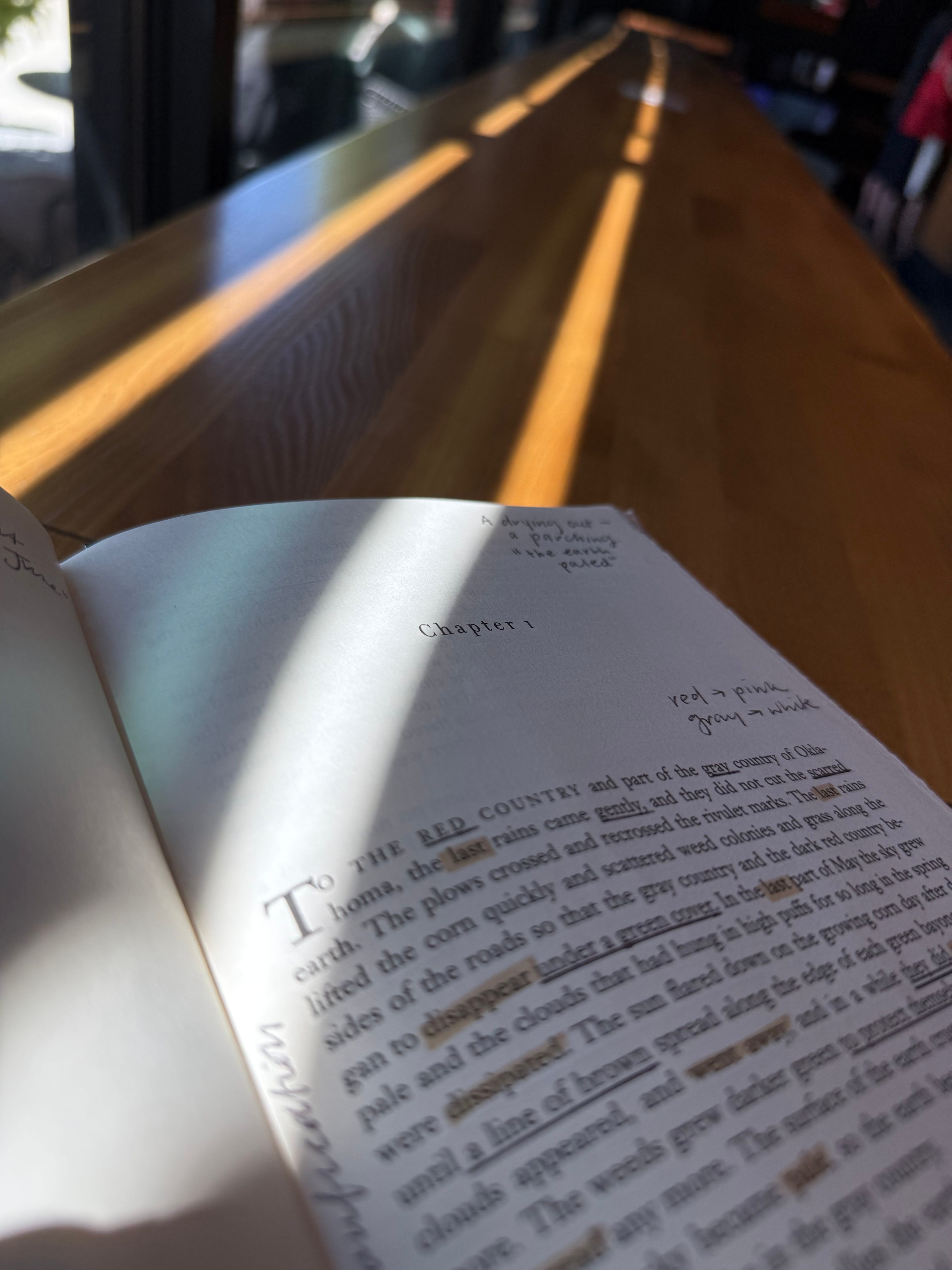
The first sentence of the novel plants us in a very specific place: in the red and gray countryside of Oklahoma.
We enter the story in a season of “gentle” rainstorms that fall in such a way that they do not seep into the ground; the rain is not strong enough.
This is a place of “scarred earth,” a phrase that denotes old, knowing land — it has scars. Not fresh wounds, and in fact, the rain cannot pierce the callouses of the land. The rain and the ploughs merely mark the land, as an apocalyptic vision unfurls on the page.
Dust Bowl context
I hope it’s not a spoiler to say that this novel is, famously, about The Dust Bowl — the epic years of drought Timothy Egan writes about in his nonfiction telling of this historical moment in The Worst Hard Time. (I highly recommend it.)
The Dust Bowl, at its peak, covered one hundred million acres of land in the United States. A quarter of a million families fled in the 1930s. But even more stayed, and as Egan writes, “not much was heard about the people who stayed behind.”
Sunday, April 14, 1935 was “the worst duster of them all,” and came to be known as Black Sunday. It was a day that hauled an unfathomable amount of dust into the skies:
“The storm carried twice as much dirt as was dug out of the earth to create the Panama Canal. The canal took 7 years to dig; the storm lasted a single afternoon.” - T. Egan, The Worst Hard Time
A fictional rendering of a real moment
Steinbeck places us in the increasingly dust-riddled landscape of Oklahoma — the worst “dusters” have yet to come, and the small society living off the land and building family farms in the area are hung in suspension and confusion. What is happening? Where is the rain? Why is there so much dust?
Part of the reason I wanted us to read DeMott’s introduction in Working Days before getting into the novel was to call our attention to that “participatory rhetoric” that Steinbeck generates in his prose.
Do you feel it?
He tells the story as if we are sitting next to him, witnessing the graying landscape beside his own gaze.
The novel opens, like his other beloved novel, East of Eden, with a sustained gaze on land. Color, country, weather.
The rain is insufficient — a harbinger of dryness and discomfort to come.
He wants us to imagine what the sky looks like. What the air feels like. Descriptive with purpose: so that you might understand it, yourself. Put yourself in that landscape and perhaps you’ll close that readerly distance with him, find yourself collapsed into what it feels like to inhabit this place, this moment in time, where “the air was thin and the sky more pale; and every day the earth paled.”
(The rain acts, in the novel, like those final “normal” days before the zombie outbreak, or the peaceful final moments of clarity before confusion hits.)
As I read a second time over the first paragraph, the word “last” leapt from the page, appearing three times with similar words: disappear, dissipated, and went away. I mark these instances with my dust-colored highlighter (an unintentional choice but one certainly informed by the novel).
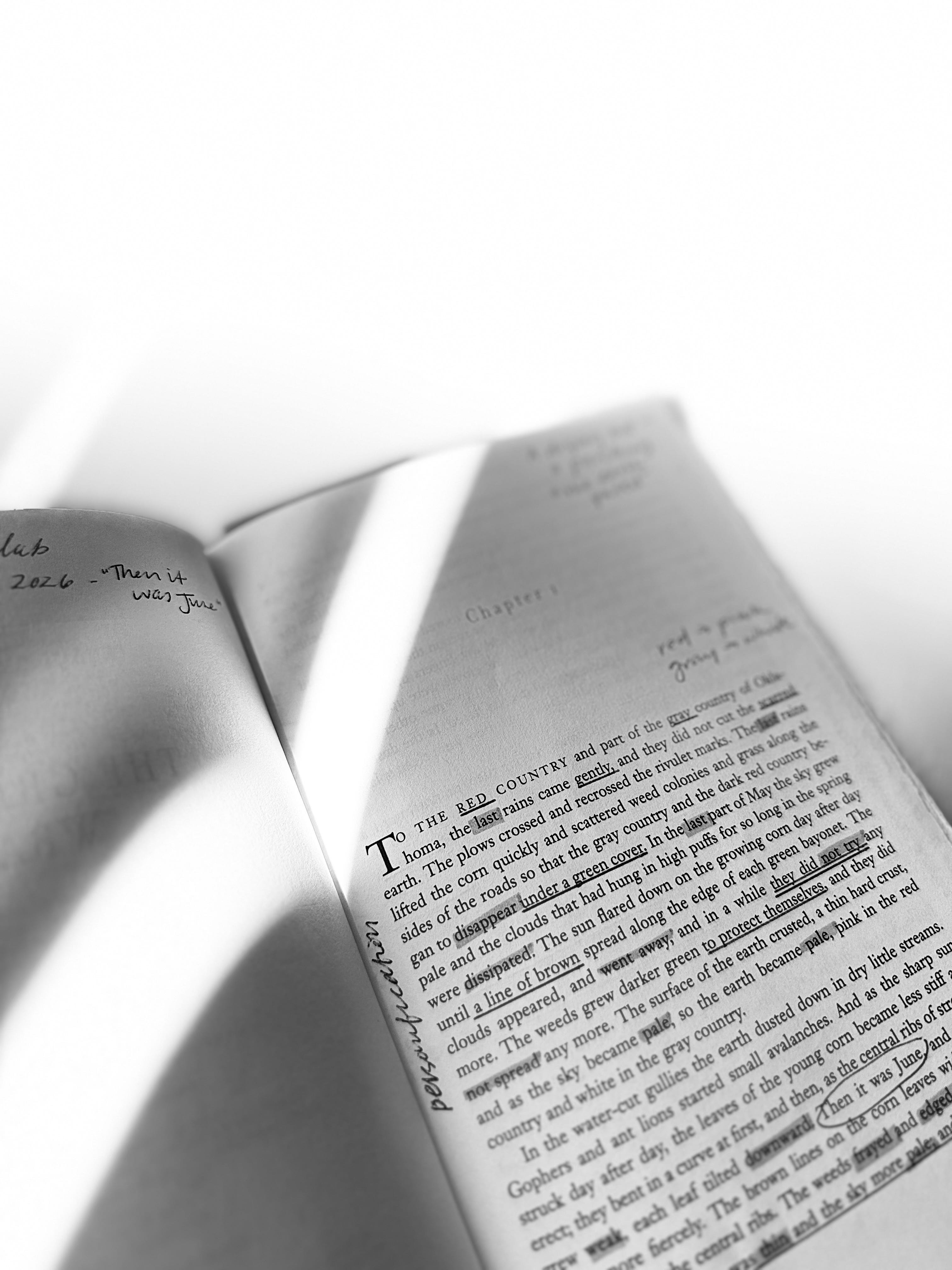
By the end of the first paragraph, we’ve born witness to a withering — a paling, as colors fade, rainwater fails; the “sun flared” and “a line of brown” edges all the green that grows.
We join Steinbeck on the brink of drastic change, poised for the disaster to come.
“What’ll we do?”
“I don’t know.”
We don’t meet any people within this landscape until the third paragraph, and then “the teams” of horses and human belong to this land. They are in ecosystem with it, and it is very clearly their activity that causes the dust: “Every moving thing lifted dust into the air…The dust was long in settling back down again.”
We witness this shift, and this great paling, as it starts to erode the social life and human routine, taking place on the land. Cloth is stuffed around cracks in the door frame; noses are covered and layers of dust are brushed from shoulders. We witness them in stunned silence; perhaps you, like me, started to imagine how you would feel there — watching the sun flare, the dust rise, and the rain fail.
When does a pattern turn into a reality? When does the dust become unbearable?
Heartbreaking questions emerge as we read — highlighting the social frameworks, and systems of dependencies, on the land. Women and children reliant on “their men” to have all the answers.
The first chapter closes not on the landscape again, but on the men sitting in the “dust-blanketed land,” puzzling over what to do.
This is the apocalypse, arriving.
Become a paid subscriber to access
“Extra credit” posts with homework assignments and free writing prompts
A comprehensive reading list of “what to read after” The Grapes of Wrath
An invite to a live Zoom meeting to discuss the novel in August
The full archive of all past book guides + essays
📚 $25/year | The classic close reader
✨ $50/year | The sustaining member