

Welcome to "The Grapes of Wrath"
Welcome to a special Summer Session of Closely Reading, where we’re slowly reading John Steinbeck’s The Grapes of Wrath along with companion reads, all summer long. You’re welcome to join us any time. Paid subscribers will be invited to a live video chat with me at the end of the session, in August.

Dear reader,
Off we go, into our summer read of The Grapes of Wrath!
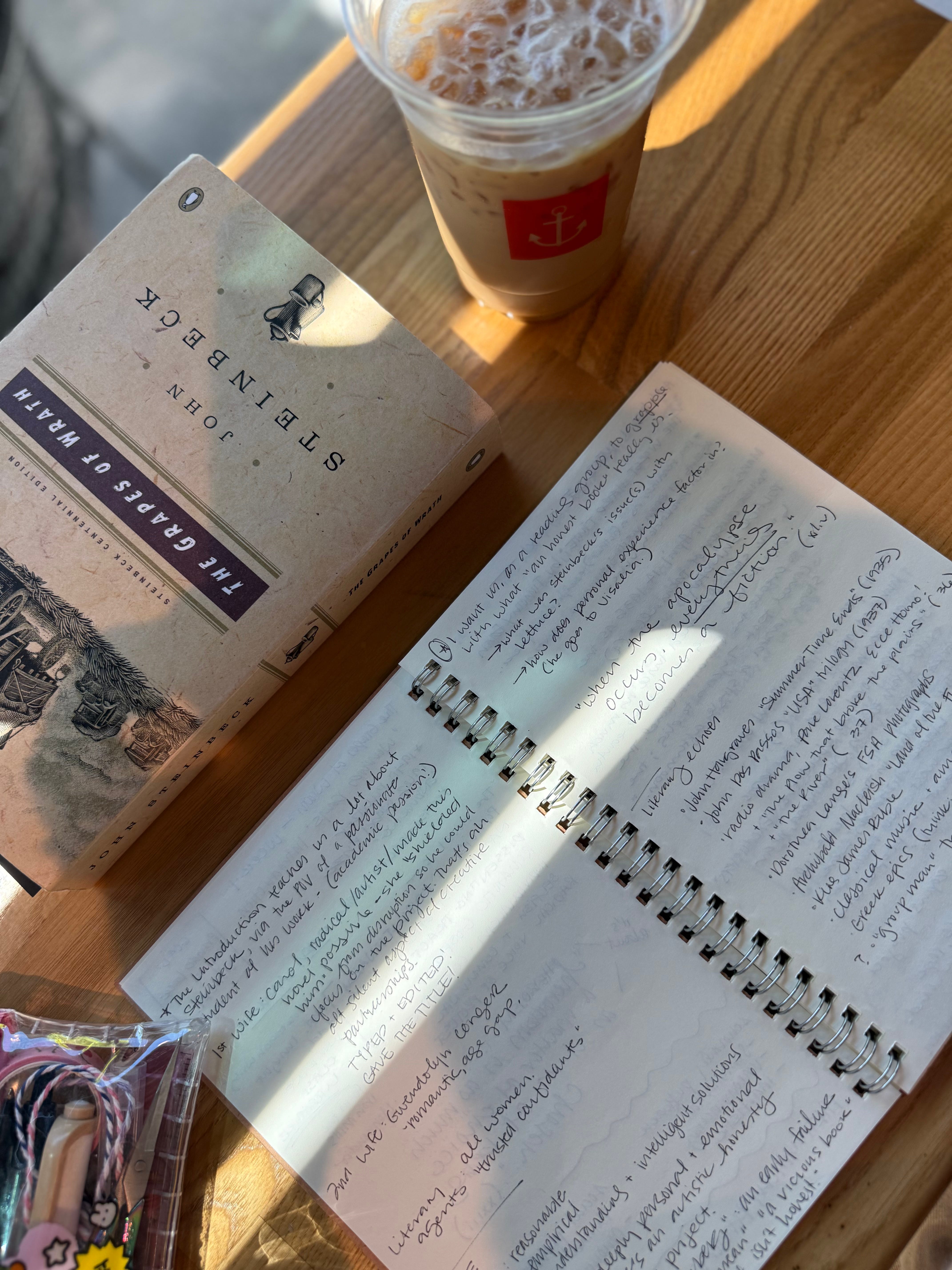
Today marks our starting line, and I’ll be sharing critical context + my thoughts on the introduction of Robert DeMott’s Working Days. (The Journals of The Grapes of Wrath, which have been compiled in this collection and provide excellent insight to the author’s mind.)
My recommended editions —
→ The Grapes of Wrath (Be aware: this edition has deckled edges!)
→ The Grapes of Wrath (Penguin Classic: this edition has normal page edges!)
→ Working Days
What makes The Grapes of Wrath so American?
In the introduction to Working Days, DeMott calls The Grapes of Wrath a “truly American book.”
What the heck does that mean?
While we find issues of class, race, economics, politics, family, love, death, morals, education, travel, weather, etc, etc, across the entire world of literature, American literature tends to be typified by some key tensions within these topics that we can watch for, as readers:
Manifest Destiny
Frontiers, opportunity, and capitalism
The American Dream
Trouble with the past; obsession with the future
The accumulation of wealth (as gold, in McTeague, for example)
Regional differences
As we dive into the novel, I’ll zero-in on some of these areas as we encounter them or see hints of them in the text. For now, let them bubble up to “top of mind” as we get into the novel.
What genre is The Grapes of Wrath?
I also want to flag three specific sub-genres of literature for you, as way of laying context for us.
When we’re looking at the formal study of American literature, there are specific sub-genres that can help illuminate patterns for us in really helpful ways — creating connections and tying back to other texts we may know or know about.
Naturalism
If you read McTeague with me this spring, you already know about literary Naturalism. This is a sub-genre of literary Realism in which characters experience a profound lack of free will and find themselves thrown about the universe with hostility, violence, and even carelessness.
Regionalism
A new (for us) genre I want to lightly introduce today is literary Regionalism — which sparked into being during the 1920s and 30s, and which is typified by a rural focus, interest in agrarian life and the laborers who live it, and a style devoted to clarity and reality (while avoiding artsy “abstractions” that would make a story harder to understand for those without formal art education).
As you might guess from the name, Regionalism is also deeply invested in a specific place. It cares a lot about the weather, the climate, the land, the skies, and the overall ecosystems of beings within a given time in a specific moment. (It’s a bit photographic in this way — capturing scenes with precision and truth.)
Regionalist authors you might know include Sarah Orne Jewett, Mark Twain, Faulkner, Kate Chopin, and Willa Cather.
In many ways, you can think of this genre as being interested in the non-academic reader — the blue collar worker, the farm laborer, the rural communities.
Social Realism
Butting right up against these two sub-genres is another one, Social Realism, which is deeply intertwined with Regionalism but opens the door to more movement beyond a single place.
Social Realism is journalistic in its approach: democratizing ideas for the most fundamental understanding. Like a regionalist will capture the unique dialect of a place, Social Realism will, too — but it’ll more likely do so in a way that highlights class or political tensions.
Authors you might know here are Rebecca Harding Davis, Tillie Olsen, Richard Wright, John Dos Passos (who Steinbeck read closely) and James Baldwin.
Social Realism also tends to have an undercurrent of protest energy. It’s a literature of the working class, interested in proletarian needs, desires, and feelings.
The Grapes of Wrath sits in the center of genre + social tensions
As we learn in Robert DeMott’s introduction to Working Days, The Grapes of Wrath is Steinbeck’s passion project about The Dust Bowl and the “exoDusters” who left a ruined Midwestern landscape for a better life elsewhere.
(Here, those “distinctly American” themes emerge: Manifest Destiny, Frontier expansion, pursuit of the American dream…)
The novel was written and published in 1940, and later contributed to Steinbeck’s win of the 1962 Nobel Prize. DeMott calls the novel “enduring,” across time, having been translated into nearly every language in the world.
The novel is:
Populist and revolutionary (that’s Social Realism)
A Naturalist epic (that’s, uh, Naturalism)
Dissenting tract (that’s Social Realism again — protest energy!)
Romantic gospel (that’s Regionalism, tinged with Romance—think Little Women)
And the novel centers on key tensions and questions:
Where does the individual end and the community begin?
What is selfish action and what is community action?
What is radical protest and what does it sound like?
Because of this unique cocktail of elements, it’s perhaps no surprise the novel has regularly been part of book bans and has been denounced by right-wing thinkers as dishonest and sentimental. Even scholars have troubled to place the novel—despite clear connections to American sub-genres of literature, Steinbeck has historically struggled to make it onto syllabi.
I personally witness this throughout my three degrees in English literature, during which I took over 12 American literature courses, in none of which Steinbeck appeared. The sole Steinbeck novel I read as part of my formal literature education was Travels with Charley for a course on non-fiction writing.
Scholarly pushback typifies Steinbeck as sentimental, unconvincing and even “inartistic” as DeMott summarizes it.
In part, this may be to do with the fact that Steinbeck, like Rebecca Harding Davis and Tillie Olsen, unabashedly addresses the working class with a “participatory rhetoric” or style of writing that insists you see the horrors, witness the mess, understand the pain.
I continue to wonder why Davis and Olsen make it into syllabi while Steinbeck remains beloved by the public and off the reading lists for PhDs. Perhaps we can explore this together as we read?
What is an “honest” book?
Perhaps the most interesting part of the Introduction to Working Days was learning about Steinbeck’s earlier attempt at storytelling on the Dust Bowl: his short novel, “L’Affaire Lettuceberg,” which he later told his editor was “ferocious, mean,” and “a vicious book” that “is bad because it isn’t honest.”
As you reflect on Steinbeck’s road to The Grapes of Wrath, it’s worth asking:
→ What was Steinbeck’s issue with “Lettuceberg” as a project? As a piece of art? As protest literature?
→ How does personal experience influence an author’s writing, especially when they are not themselves of the class about which they write? (Think back to our reading of “Life in the Iron-Mills”!)
I really want us to explore this together, especially as we start to get into the tone and voice of the novel itself. DeMott suggests, and Steinbeck himself writes, that in order to successfully tell the story he wants to tell, he needed to find a tone and a style that was not “vitriolic” in nature.
Let’s look at why — in Steinbeck’s own words.
“I can’t beat the argument but I don’t like the book. And I would be doing Pat [publisher] a greater injury in letting him print it than I would by destroying it. Not once in the writing of it have I felt the curious warm pleasure that comes when work is going well. My whole work drive has been aimed at making people understand each other and then I deliberately write this book the aim of which is to cause hatred through partial understanding. My father would have called it a smart-alec book. It was full of tricks to make people ridiculous. If I can’t do better I have slipped badly. And that I won't admit, yet….I’m not ready to be a hack yet.”
Here, Steinbeck himself explains that his early attempts at the story he tells in The Grapes of Wrath were not sufficient for the aesthetic and empathetic cause he had set forth upon. He was a “smart-alec,” using cheap “tricks” to get people to feel a certain way; to sway opinion, even to “cause hatred.”
He finds himself capable of using “partial understanding” to hurt people — and instead of giving into the impulse, thank god, he denies it.
I couldn’t help the heartache while I read this section of the introduction. There’s something noble here, something that feels increasingly rare in our current moment of rage-optimized algorithms and contagious anhedonia. Steinbeck recognizes his potential to do harm, and chooses another path.
I can’t help but wonder if L’Affair Lettuceberg would’ve created a different reputation for him; would scholars have loved it? Would the right-wing have embraced it? Would the proletariat have felt heard, or hurt?
I know from East of Eden that Steinbeck speaks tenderly to the parts of me that have sometimes been refined too much by academic training or the seemingly inherent cynicism of life as a Millennial. I admire him, so much.
I suppose I want to be frank with you, my fellow readers, that I’m already feeling a bit defensive of him based on this Introduction, and eager to experience this novel with a wide-open heart.
What about you? {An invitation to free write!}
As we get into Big Book Summer together, I invite you to check-in with yourself. Set a 17-minute timer and explore your thoughts:
→ What biases or assumptions are you bringing with you?
→ What tenderness or openness are you bringing?
→ What cynicism or closed-offed-ness are you bringing?
As I’ve mentioned before, self awareness is a meaningful piece of deeply reading and of getting “close” to a text, because it tests how close we’re willing to get, in ourselves, against big and often difficult ideas.
(Scholars like to pretend close reading has true objectivity in it; I find it a tightrope we learn to walk, a process undergoing constant change, like ourselves.)
Become a paid subscriber to access
A comprehensive reading list of “what to read after” The Grapes of Wrath
An invite to a live Zoom meeting to discuss the novel in August
The full archive of all past book guides + essays
📚 $25/year | The classic close reader
✨ $50/year | The sustaining member