
A haunting philosophical exploration of life and death
Well, readers, it seems that we are living in an era of AI overtaking book discourse, even if we haven’t yet (and hopefully never will) arrived at the era of AI taking over books. This week, The Atlantic cast AI aspersions on a very popular self-published novel on the eve of its traditionally published release. Then a duo of literary agents withdrew their support for a duology that was under contract for over 2 million dollars. And then there was the news of Anthropic literally destroying books in an effort to scan and metabolize their contents quicker. The accusations, the actual AI usage, the destruction of books…it all feels very dystopian.
Amidst it all, Substack announced a partnership with Pangram, a company that uses AI to scan text for AI. There has been both outrage and applause since this announcement, and after the initial wave of furor, Substack introduced the ability for any newsletter writers to opt-out of having their work scanned. I have to admit that from where I sit right now, I don’t have a take on this issue. I can see both sides and I don’t know enough to come down any which way. I think AI slop is a problem on Substack—I’ve come across enough newsletters that are clearly generated by AI to understand why some sort of check is desirable. And yet I get the concern from writers. Right now, I have questions, but no answers. How reliable is this service? What happens if something I actually wrote gets flagged as AI? Should we outsource our own thinking and discernment about what AI writing looks like to AI? Isn’t the thing I actually oppose the outsourcing of thinking and discernment in the first place? What does it even mean to have our writing scanned for AI? How is our work being used in ways we don’t expect? And what do you as readers feel about all of this?
In the chaos of all of this questioning, I am trying to be open-minded about AI usage for others. I have no desire to read a book (or a newsletter) generated by AI, and I would be ashamed to use the tool to create my own work. But I suppose I am open to the idea that people can use it well in the right circumstances and even that there might be newsletters where using AI to draft or edit is okay, if it is disclosed. Mostly, I think it is dangerous to divide ourselves into factions around this issue right now. There is so much we don’t know, and I worry that jumping straight into the “it’s all evil” or “there’s nothing to worry about” camps will limit our ability to think through this issue as things evolve. We’re in uncharted territory and the more we talk to each other honestly about our thoughts, feelings, and usage of this paradigm-shifting tool, the better.
Personally, my biggest concern with AI is not (at the moment) the abundance of slop, but the way it will change human thinking and writing. Back in March, when my dad was declining, I used Claude to generate short summaries of some of the texts I had selected for a This American Lit syllabus. I needed a short cut that week, and it was right there. I didn’t end up using the Claude summaries because I hated the way they sounded—AI seemingly can’t help trying to sound clever and turning every sentence into a mic drop moment. Plus after reading what it generated, I’m convinced that the machines can’t accurately articulate why any one book speaks to the human soul. But as I started penning my own summaries after reading Claude’s, I realized what I had read from the AI chat was still in my head. I became mentally anchored to those sentences and found myself unconsciously imitating some of the the mechanistic phrasing. These are the sort of effects that I find most terrifying—the more we use AI, the closer we get to conflating the predictive language generated by a machine with our own thoughts.
I am glad that I’ve played around with AI a bit because now I feel I can better detect AI “writing.” But I also fear that the more we interact with AI—and we might be doing so even unknowingly—the more we ourselves will come to use its habits and ticks. I bring this up not because I’m worried about false detection on Pangram, but because I’m worried about our brains. AI has been trained on real human creativity. It then spits out generative text that human brains read giving it real power to shape and change our brains because everything we read changes our brains. I want no part of that and it freaks me out to think about people passing off AI generated text as their own—we should all have the right to knowingly determine what we take in. I am avoiding judgment on folks who openly and honestly use the tool, but I don’t want to be tricked. As my podcast co-host Liz Hein tells the students at her school, you’ll know if you’re using AI “correctly” if you feel proud to share how you did it, not ashamed to be found out.
As for this newsletter, FictionMatters will remain 100% human written. This is the space where I exercise my brain, and I’m not going to be handing that over to a machine anytime soon. Please know that I value your mind and your time, and (this is super cheesy but…) it means something to me that we are separate human beings whose minds are meeting through these silly little screens.
I know this was a lot of throat-clearing and nonsense—this new reality feels so strange and while I wish I could totally ignore it, it felt worthwhile to say something. It feels incredibly stupid to assure you of my own humanity and surprisingly difficult to write anything about this without it coming across as protesting too much. I hope I never have to write about AI and newsletters ever again, but if you ever have any questions about what goes on behind the scenes here, please never hesitate to reach out!
Alright, enough on the machines, let’s get to the books.
Once again, I have been loving the conversations happening on these posts, so please tell me about your week in books in the comments below!

This week I read…
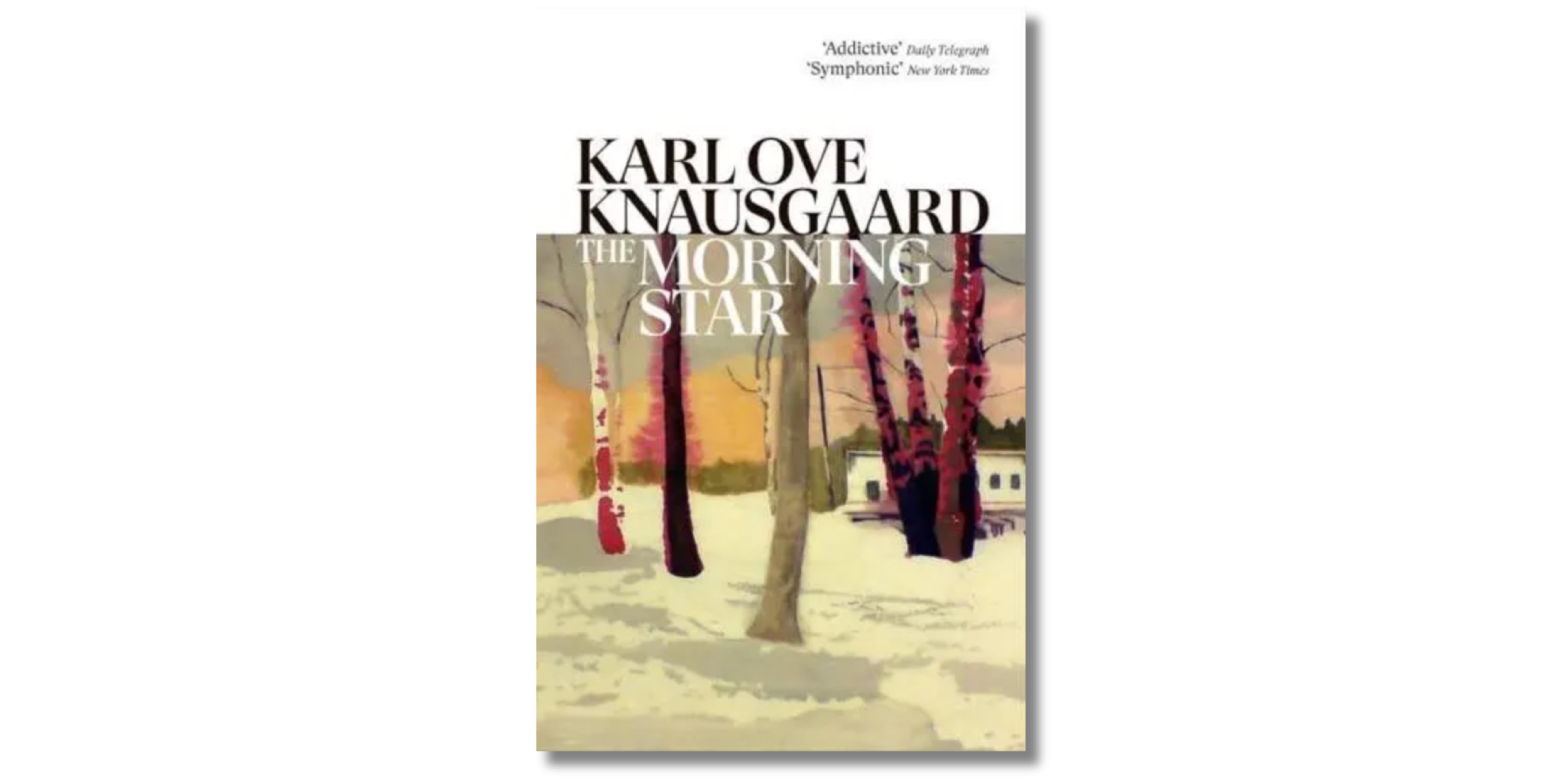
The Morning Star by Karl Ove Knausgaard. I spent all week with this big book and it was an incredible reading experience. Many, many people have tried to persuade me to read this—I feel like Knausgaard inspires a sort of evangelical zeal in his readers, and now I get it. Not only is this book very good and very thought-provoking, it is kind of difficult to describe, making it the perfect “just trust me” book. The first book in The Morning Star series begins in a Norwegian summer house where Arne begins to notice that his wife is behaving erratically. We get the sense that this isn’t the first time it’s happened and that these episodes can occur to varying degrees of intensity, but this one results in a gruesome accident that creates a sense of foreboding that permeates the entire novel. As the chapter ends, strange things have begun happening in the natural world as well, including the appearance of a new star in the sky. From here, Knausgaard follows many (I didn’t count, but I think upwards of 10) point-of-view characters in their regular days, made irregular perhaps by the appearance of the or perhaps by the doubts and anxieties that have always plagued them.
I was surprised at how propulsive this novel is. I was expecting something deep and philosphical, but while it definitely delivers on that, I was also desperate to know what was going to happen pretty much from page one. This does, however, require a patient read. Characters are introduced and then not circled back to in this book, although my understanding is many are reintroduced in book 3. Each character is deeply flawed and I loved the way I got to unearth their struggles and desires as the plot raged and transformed into something resembling a true horror novel. And the end! Talk about a mind-blowing conclusion that was weirdly perfect to read after having just seen The Odyssey. I’m going to wait to read further into the series before I decide what level of evangelism I am prepared to harness for these books, but I whole-heartedly recommend this first one for readers who love dark, philosophical literary fiction and are looking for something simultaneously compelling and brainy. Bookshop | Libro.fm
Now I’m reading…
I went from one big book straight into another and am reading The Song of Stork and Dromedary by Anjet Daanje—it’s fantastic. I’m also listening to Julie Buntin’s Famous Men, which is smart and compulsive.
New on my TBR…
All books! Will you be reading any books from this year’s list?
💬 Tell me about your week in books! What did you finish, what are you reading now, and what have you added to your TBR?

22 books coming out in August. (NYT, gift link)
Authors shared the best books to read in July, but if you missed it, I’m sure August will suffice. (The Guardian)
The 13 best book covers of July. (Lit Hub)
Three books Sheila Heti recommends. (New Yorker)
What I learned from a close read of all of Colson Whitehead’s books. (Lit Hub)
What truly imaginative fiction can do. (Atlantic)
Who is Emma M. Lion and why can’t readers get enough of her? (NYT, gift link)
Why animal narrators are all the rage. (Atlantic)
Why Americans can’t seem to quit Little House on the Prairie. (Lit Hub)

In the last week, we’ve finally started making use of our community pool. We live half-a-mile from a recently redone public pool, but for some reason had never been. Readers, we have been missing out. It’s a fantastic spot with shady grass for picnics and a kids area that is perfect for Louise: a splash/slide zone and a larger 3-foot deep area where she can practice her swimming. I don’t know about where you live, but the private pool club thing is very popular in Denver, and each one costs a fortune and has a years-long waitlist to get in. But our public pool is $3 for adults and $1 for kids, and we get to hang with our neighborhood. It’s incredible and I feel like a dolt for not having gone sooner. Most of you reading this probably are not in Denver, but this is a PSA to investigate if you have a public pool near you or to go on a mission to discover some other wonderful community resource near you.
We finally got hooks for our front entryway and I adore them. These cost a small fortune, but I love that they feel like functional art.


For questions, comments, or suggestions, please don’t hesitate to reach out by emailing fictionmattersbooks@gmail.com or responding directly to this newsletter. I love hearing from you!
This email may contain affiliate links. If you make a purchase through the links above, I may earn a small commission at no additional cost to you.
If you enjoyed today’s newsletter, please forward it to a book-loving friend. That’s a great way to spread bookish cheer and support the newsletter!
Happy reading!