
July Reads
My relationship to reading has changed a lot this year. I have spoken about it several times and, generally, have managed to accept the reality that I cannot read as much as I used to. On paper it is a good thing - I am reading less because I am not bed-bound anymore. But regardless of the ‘good’, I found myself feeling quite sad about it this month. I really, truly miss that volume of reading and the insatiable reader I used to be. I miss how many worlds I could visit in a month, how many different lives and experiences I was able to inhabit. Over the course of July it has become increasingly apparent to me that I am grieving not being able to read as much anymore.
I think people get confused with this statement, quickly reassuring me that reading four or five books a month is still a lot! While well intentioned, these comments are missing the point entirely. It’s not really about the volume (though it may look like it), it’s about the incredibly heavy emotions that come with long term sickness and identity. Reading became incredibly intertwined with my sense of self, and identity, throughout that time. Though always a reader, I didn’t become the voracious one you know me to be until I became sick. Thus, my relationship to reading is often a direct reflection of my ‘health’.
It is hard for me to separate reading from my sense of self, to detangle the complex intertwining that exists between it and my health issues. Both aggressively arrived in my life at the exact same time, and I would not have become such a dedicated reader if I was not sick - I know that to be true. I just need to figure out my new reading identity and a new rhythm. I am typing this while looking at the most enormous stack of books I am dying to read, and I hate that I can’t get to them quick enough. This may sound incredibly obvious, and a bit ridiculous, but I do truly feel like I am grieving. Maybe I need to hold a wake (a joke) or maybe I should write something reflective about how reading saved my life, but I don’t need the life jacket as desperately anymore (a sincere suggestion).
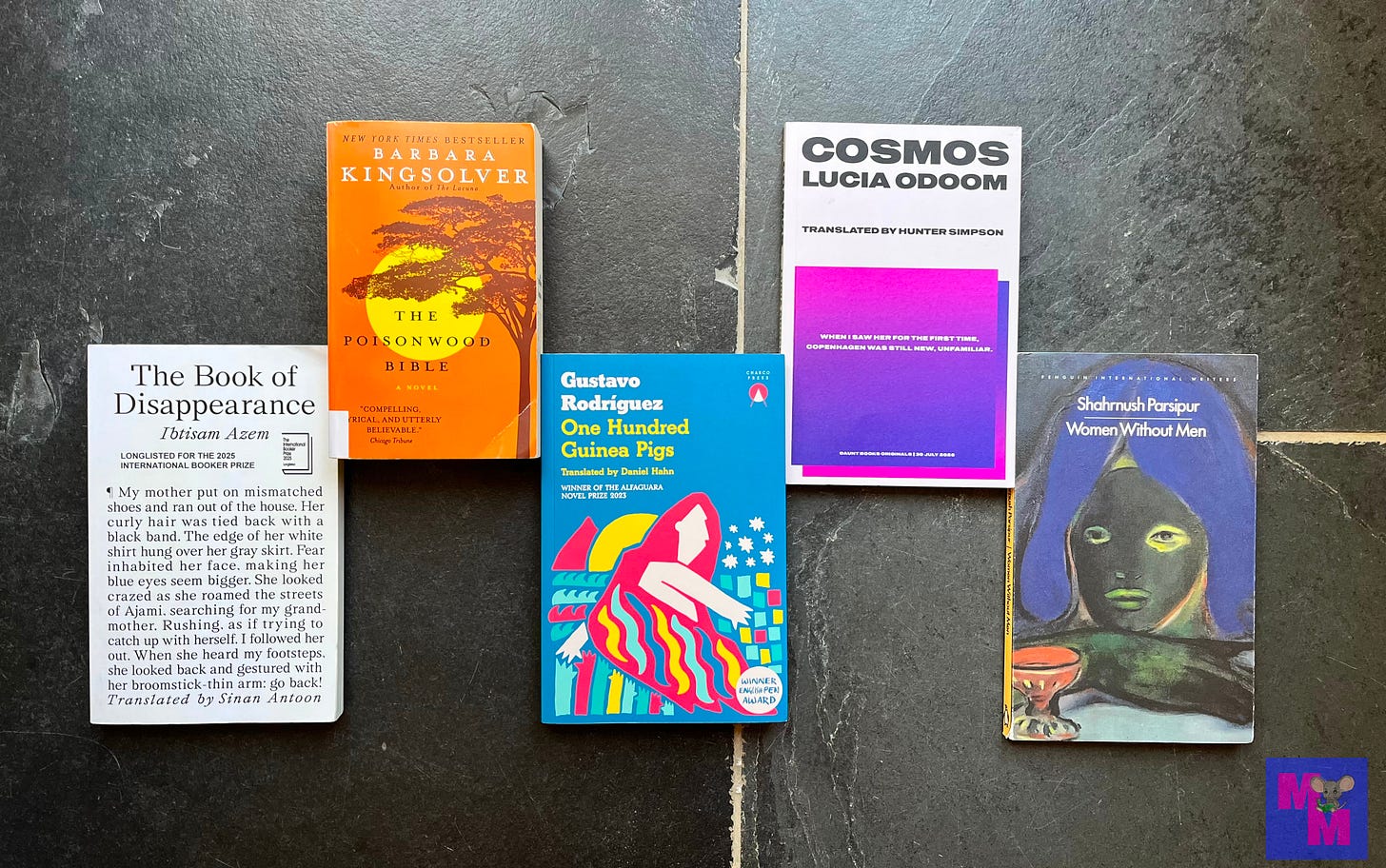
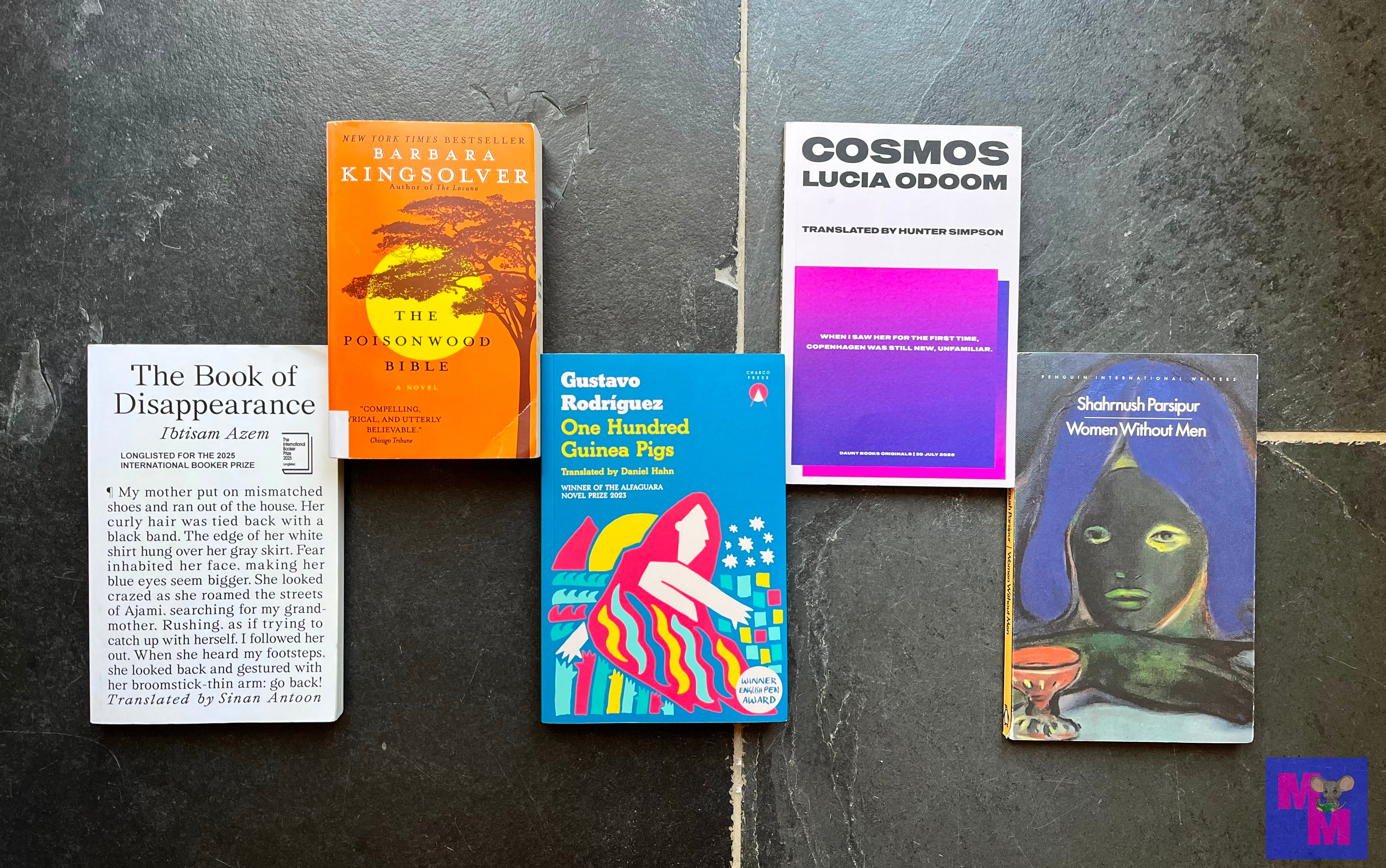
It’s funny how we grieve change we once begged for. How funny the human experience is! Anyway, here’s to July - a good reading month! Only five books, but I earnestly enjoyed every single one for very different reasons.
To see the translated reads from July on Martha’s Map, including authors from Iran, Palestine, Denmark and Peru, click here.
For those who are new, buy, borrow, bust is my recommendation key: Buy = I loved this book and highly recommend it. Borrow = I liked this book and think it is worth a read. Bust = I wouldn’t recommend this book from my reading experience.
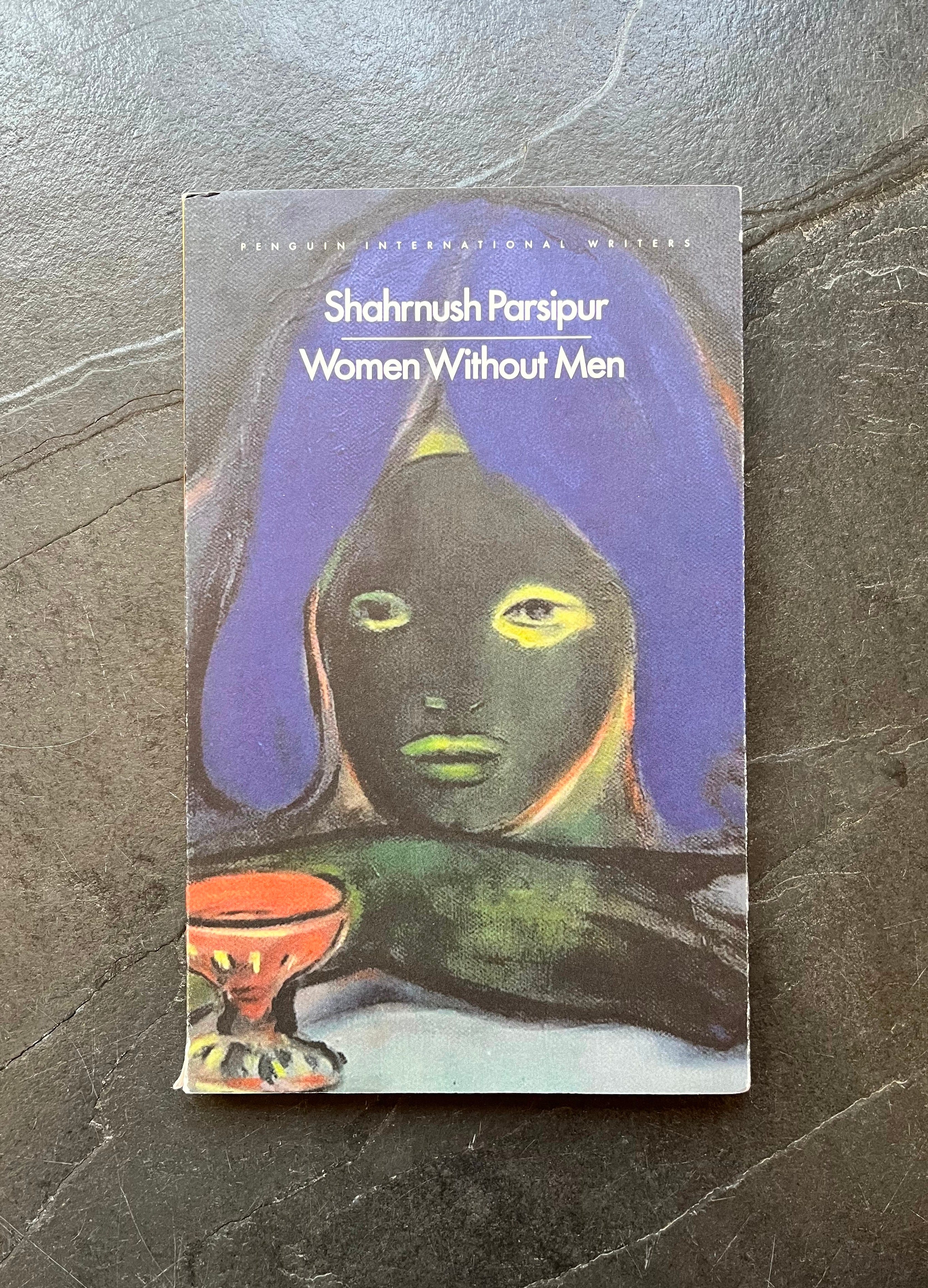
‘Women Without Men’ by Shahrnush Parsipur (translated Faridoun Farrokh)
I read Women Without Men on the day that Pasipur passed away last month. Unbeknownst to me, I was reading one of her most pivotal works that irrevocably changed her life on this planet just as she was leaving it. The incredibly poetic coincidence stunned me, and made me smile about how beautiful it is that books outlive their authors. That we are left with these seminal pieces of work that have the resonance to withstand the passing of time to connect with readers for eternity.
Women Without Men is the intertwined tale of five women - including a wealthy middle aged housewife, a sex worker, a school teacher - about their life in Tehran in the 1953 coup d’etat. Together they seek freedom from patriarchal oppression by fleeing to an abundant garden on the outskirts of the city. Blending magical realism with the horrific reality of life for women during the coup d’etat, the novel is a poetic and political portrait. While the women vary in economic standing, they are unified by the social standing that is given to them by their gender.
The central theme is the social construct of virginity and how the myths and miseducation around it is used to control women. Parsipur’s prose are cutting and direct when discussing how purity is not a status that is inherent to being virginal;
‘At the age of eight she has been told that God would not forgive a girl who lost her virginity in any way. Now, a couple days ago she had learned that virginity was not a curtain but an orifice. Something had broken inside her and a cold rage penetrated her body. She thought of her childhood days when she had longingly looked at hedges and trees, hoping for a time in her life when she could freely climb them without compromising her virginity. Her knees felt like ice’ 1
It is these matter of fact moments, where Parsipur’s narrative is instructive, that we are reminded that this was, and is, more than a novel. Through these five fictional women, Parsipur directly addresses the women in Iran, offering frank commentary about their sexuality and status in society. The book had huge underground success in Tehran in 1989, and was kept in print by being secretly passed around. It is also why Parsipur was sent to prison in 1990 for her depiction of women’s sexuality, because it was considered a danger to Iranian women.
A title nod to Hemingway’s ‘Men Without Women’, Parsipur suggests that the patriarchy, and the violent ways it is imposed and used to coerce women, is the rotten core of societies across the world. While focused on Iranian women and the extreme circumstances they have historically, and currently, live under, there is a universality in how the patriarchy is insidiously used to dictate, and suffocate, the lives of so many.
A defiant rage can be felt in Parsipur’s voice throughout as she condemns the policing of, and violence towards, women’s bodies. Women Without Men is a harrowing, funny and political story about men keeping women suspended in fear in order to control them. This book reminded me of a film I saw last year, The Seed of the Sacred Fig, shot entirely in secret in Iran. The vibrancy of the women in this film, and the book, remind us that under oppression there is always creativity, humanity and bravery that cannot be destroyed. It is utterly devastating to know that this novel has not lost its relevancy, that the events are just as much a reflection of the past as they are of the present.
I was deeply impressed with how Parsipur made me feel with her succinct prose that carried an insurmountable weight. Women Without Men is enthralling in its defiance, incredibly poetic and beautiful in how it explores what it is like to live as a woman under such strict Islamic rule. While her bravery is an obvious reason to read this novel, another lies in just how excellent it is. I thoroughly enjoyed this, would recommend it and call it a buy! My research suggests that we will see more translations of Parsipur’s work in 2027 and 2028, including her ‘Prison Memoir’, which I am incredibly excited for. For more Iranian related stories, I’d recommend ‘Prisoner 951’ about Nazanin Zaghari-Ratcliffe. If you have no idea who she is, I’d highly recommend having a read.
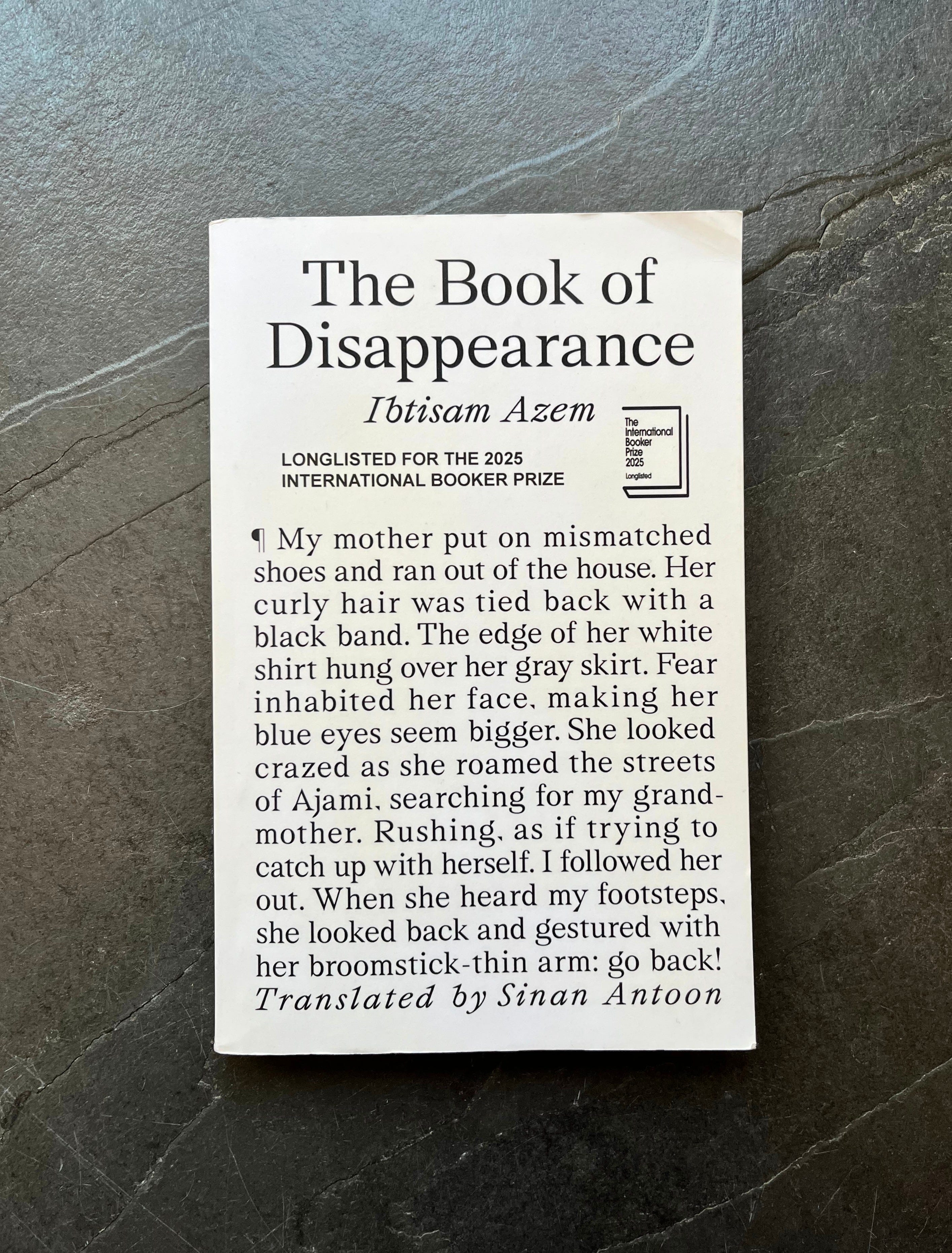
‘The Book of Disappearance’ by Ibtisam Azem (translated by Sinan Antoon)
Alaa, a young Palestinian, is haunted by his grandmother’s memories of being displaced from Jaffa and becoming a refugee in her homeland. He writes to her, constantly, in his diary after her passing, troubled by the questions he did, and didn’t, ask about the Nakba. Ariel is Alaa’s friend and neighbour, a ‘liberal Zionist’ who is critical to the military occupation of the West Bank but believes in the project of Israel. One morning Ariel, along with the rest of Tel Aviv and Jaffa, wakes up to find that all Palestinians have suddenly disappeared. They are horrified by this secret disappearance, and Ariel tries to make sense of it by searching for clues in Alaa’s home.
‘Your Jaffa resembles mine. But it is not the same. Two cities impersonating each other. You carved your names in my city, so I feel like I am a returnee from history. Always tired, roaming my own life like a ghost, a ghost who lives in your city. You too are a ghost, living in mine. And we call both cities Jaffa’ 2
This novel reminded me of Small Boat in how it deftly handles one of the most pressing and contentious debates of our generation. While originally published in 2014, this book has unfortunately only grown in its pertinence. The Book of Disappearance stylishly explores the ‘Palestinian question’ through two friends who outwardly share almost no animosity between them. But it is when Ariel starts reading Alaa’s diary he begins to understand what is not shared, and how this affects their relationship. This book creates an alternative, but instructive, world for readers to understand the contentious debate surrounding Palestinian and Israeli identities. Azem creates space for the reader in her dystopian world to imagine, and begin to understand, how this tension manifests.
The greatest books will always create a fictional world which can help readers understand the one around them with greater empathy and nuance, and that is exactly what Azem does. The Book of Disappearance is not about condemning or resolving, rather exploring the internal emotional landscape of the anguish suffered by Palestinians (to put it lightly). What struck me the most about this novel is how it helped me understand the psyche around the project of Israel. Azem eloquently articulates that there is no such thing as a ‘liberal Zionist’ like Ariel purports he is. In exploring the mass hysteria they suffer in learning all Palestinians have disappeared, we see some of the maddening, complex narratives that Zionists create to justify their incomprehensible inhumanity.
While Ariel so inherently believes he is separate to this, both his action, and inaction, demonstrate his subconscious ideology without him even realising. Azem gently puts us in the mind of the aggressor, provocatively asking the reader what they think, or feel, about how Ariel is behaving - and it is genius. Azem’s exploration of erasure and identity is subtle and compelling, forcing the reader to imagine the absolute unimaginable. Azem’s prose are as beautiful as they are depressing, made even heavier by the unfathomable, truly heart shattering reality that the genocide in Gaza is still ongoing.
I would recommend this and call it a borrow! My life interrupted reading this a lot (I read it very slowly), so I wonder with a more consistent read, I might have really loved it. Regardless, it impressed me and I loved how it gave me a different avenue to think about Palestine. Azem achieved something striking with this story, and I look forward to reading some more of her work (see The Sleep Thief).
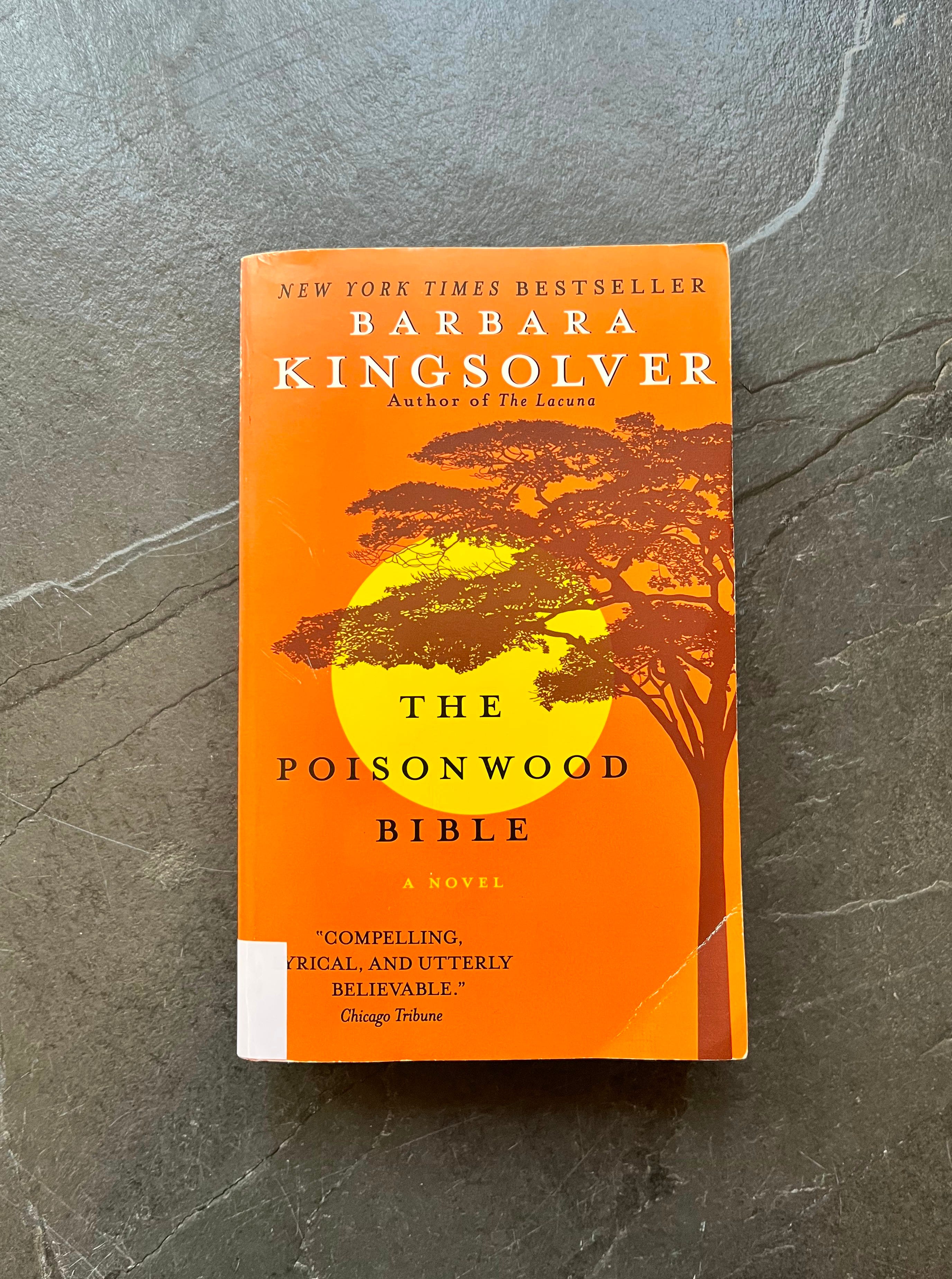
‘The Poisonwood Bible’ by Barbara Kingsolver
It’s 1959 and Nathan Price, with his wife and four daughters in tow, have arrived in the Belgian Congo on an evangelical baptist mission. They naively pack up their life in Bethlehem, Georgia, with what they consider to be necessities from home, and expect to be welcomed with open arms. Upon arrival, the Price’s quickly realise that they are unprepared and gravely ignorant to the reality of life in the Congo. What follows is one family’s tragic unravelling across three decades in postcolonial Africa.
The Poisonwood Bible is an ambitious and poignant novel that feels like a monster to review. As expected, this is another Kingsolver novel that is addictively paced with a wealth of perspectives. While this ignorant and insane mission is spearheaded by the family’s de facto leader, Nathan Price, we are blessed by Kingsolver to never have to know that man’s internal dialogue. Instead, the novel is narrated to us retrospectively by the mother, Orleanna, and in the present by her four daughters; Rachel, Leah, Adah and Ruth May. The women and girls, who all inhabit varying degrees of emotional and academic intelligence, universally seem to know that their fathers expedition to the Congo was ill considered, unwelcome and ridiculous.
Nathan Price, a hysterical preacher of the evangelical church, is hell bent on ‘saving’ the Congo, and has forced his family to come and witness his reckless ideological determination play out. Both a pariah in his family and the village of Kilanga, the Price family grows and changes through circumstances and fear which increasingly exclude him. But the brilliance of this novel lies within Kingsolver using the four girls to narrate a story that is imbued with so much religious fervour, political and historical weight. While the reader knows the obvious ethical implications of a missionary, and Nathan and Orleanna are too far gone in their indoctrination, the girls are too naive to understand the wider implications of their presence. Thus, their narrative is complex, rich and mostly without ignorance. The portrait they create of the Congo is beautiful, bizarre and honest. It is joyfully complicated to be submerged into their constantly changing perspective.
Early on, Orleanna reveals to us that one of her children is buried in the soil of the Congo, and we understand the ego driven decisions made by her husband result in dangerous consequences. Ultimately Orlenna’s passive inaction becomes just as dangerous as Nathan’s selfish and deranged religious plight. While the children become increasingly aware of this as time goes on, they offer an uncompromised and untainted perspective of a post-colonial Africa. The sincere curiosity, emotional intelligence and poetic observational ability of (most) of the girls puts their parents, and all the white adults that surround them, to genuine shame.
The Poisonwood Bible, in essence, explores how violence, racism and ignorance is a taught behaviour that is not inherent. This is further articulated by the age gap between almost a teenager Rachel, who parrots the racism she has clearly been raised around in the American South, and the baby, Ruth May, who inquisitively tries to make sense of her new environment and eagerly makes friends along the way. Between these two lie the twins, Leah, who is determined to embody her fathers ‘mission’ and Adah, a girl who doesn’t speak but embodies a shrewd poetic and emotional intelligence which is enchanting.
‘What if the Americans, and the Belgians before them, hadn’t tasted blood and money in Africa? If the world of white men had never touched the Congo at all?’ 3
Kingsolver often explores the weakness of the American identity and its obsession with ‘othering’, and this novel is no less. Gripped by the social injustice she is always determined to explore, it is an engrossing tale of prejudice, with allegories that hold up to the passing of time, despite being described as ‘heavy-handed’ by Kakutani in NYT, 1998. Crucially, I do not think she is heavy handed, at all, in her presentation of the isolation, lack of resources and brutality that characterises Africa’s past and present. Outsiders made the continent complicated, and Kingsolver does an excellent job of reminding us of that. While Kingsolver’s work does have a tendency to be heavy-handed in its exploration of morality, it is never distasteful, or wrong. Her exploration of the blindness religion imposes on those who submit to it without question is excellent, astutely suggesting that the success of religious doctrine often always relies on its ability to manipulate.
I enjoyed this, but truthfully it comes to life when we can witness how the girls carried their experience in the Congo into adulthood. But to discuss any of that would be a spoiler. Kingsolver is my guilty pleasure author, which means that there are lots of aspects to her writing that I have criticisms about, but I choose to ignore them. Her ability to create such a rich world, that spans several decades, inhabits multiple distinctive perspectives and is committed to interrogating the injustices of our world is exceptional, and I will forever admire her for it. I would recommend this and call it a buy! The ballot is now open for suggestions for the Kingsolver I should read next summer (it’s an annual thing). I had The Bean Trees suggested a few times, so I think I might pick that!
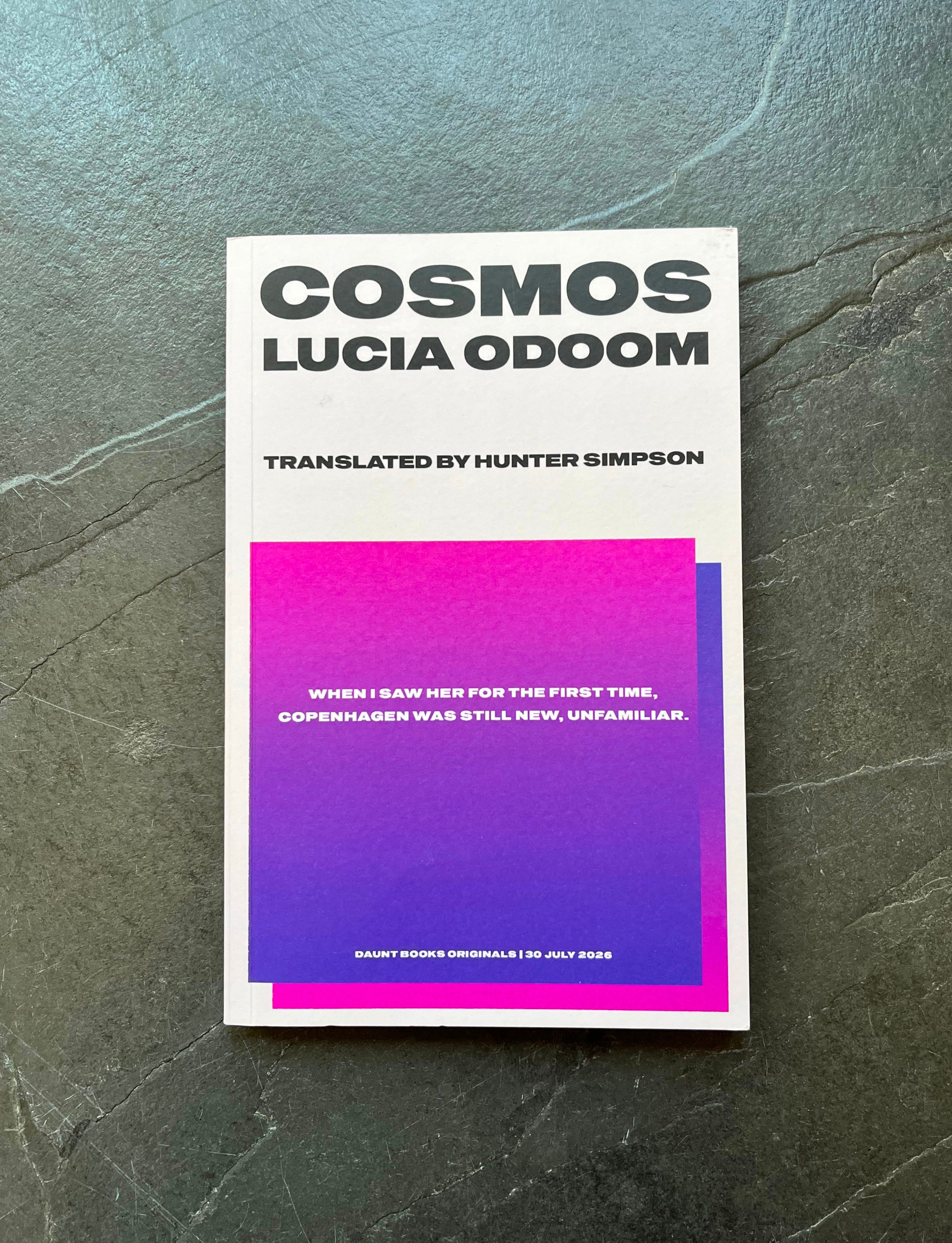
‘Cosmos’ by Lucia Odoom (translated by Hunter Simpson)
Cosmos has arrived in Copenhagen, from Ghana, to earn money to send back to his family. He arrives in the height of summer, and finds a job collecting bottles. Cosmos finds himself falling in love with Elizabeth, and spends his nights whatsapping his family back home to keep them updated on his new life.
Set over the course of five months, this epistolary novel is about what it means to truly belong. Structured around his letters to his sister, Aunt and Uncle, Cosmos is a beautifully tragic exploration of identity and safety. While the story is quite romantic, centered around the indulgent experience of falling in love, it is equally a heartbreaking exploration of economic migration. Odoom deftly, and impressively, manages to make room for both in this taut novella.
We immediately learn that Cosmos is homeless, sleeping in the Library or on benches with his fellow bottle collectors. He is acutely aware of the parallel life he is living in contrast to the white Danish population, paranoid about how he might be perceived by them. Cosmos and his friends learn how to ‘speak’ to them, careful to be the perfect balance of nonchalant, friendly and practically invisible;
‘We’re in the park where we sleep every night [...] where we know we’re guests, a place to belong to drug dealers, teenagers and families with young children. They all have their separate corners of the park, and we lie under the trees, knowing that everyone wishes we would pack our things and go’ 4
The nature of belonging quickly becomes the key theme to Odoom’s novel, and while Cosmos has found a community within his fellow bottle collectors, he is aware that these relationships do not allow him to be any more ‘accepted’ in the city. He is restless about being an outsider, self conscious that he doesn’t fit in;
‘Ever since I got to Copenhagen, I’ve been paranoid about how I smell and how I look. Am I dirty? Has the journey worn me out, dulled my youthful glow, made me ugly? 5
Though falling in love with Elizabeth temporarily suspends his restlessness, it ultimately amplifies his anxieties. Odoom presents a beautifully complex portrait through Cosmos of a man who is constantly chasing the concept of home, but never quite managing to find it. He romanticises being back in Ghana with his family, while simultaneously knowing that he is in Europe because he cannot find sufficient economic opportunities at home. Here Cosmos opens up into a much larger discussion about what it means to be uprooted, to be without a home literally, but also in a spiritual sense. While Cosmos is literally homeless in Denmark, his soul is too. Untethered to a collective identity or culture, his status of being an ‘outsider’ suffocates him.
Odoom’s prose is quietly piercing, exploring the romanticised allure of economic opportunities in Western counties. The ingenuity of this story lies in how Odoom chooses to tell it, through Cosmo’s letters which ebb and flow in frequency. In speaking to those he loves, we learn more about him, and his past, in an exceptionally beautiful way. The reader receives this uncluttered, succinct insight into Cosmos psyche; a tender look into his hopes and fears for the future, as he tries to grapple with instability. Odoom’s character development is rich and profound despite the fragmented nature of the letters, making the novel feel much longer and more complicated than it actually is. It is truly remarkable that Cosmos’ character is so rich and nuanced in just over a hundred pages.
This book was astoundingly beautiful. I read it in one sitting, arrested by Cosomo’s point of view and intense emotions. Cosmos is an incredibly poignant and moving portrait of the sacrifices some are forced to make, and the complex emotional weight, and loss of self, that comes with it. It is a beautifully painful story about everybody’s right to dignity, community and hope. I would recommend this endlessly and call it a buy! I loved it.
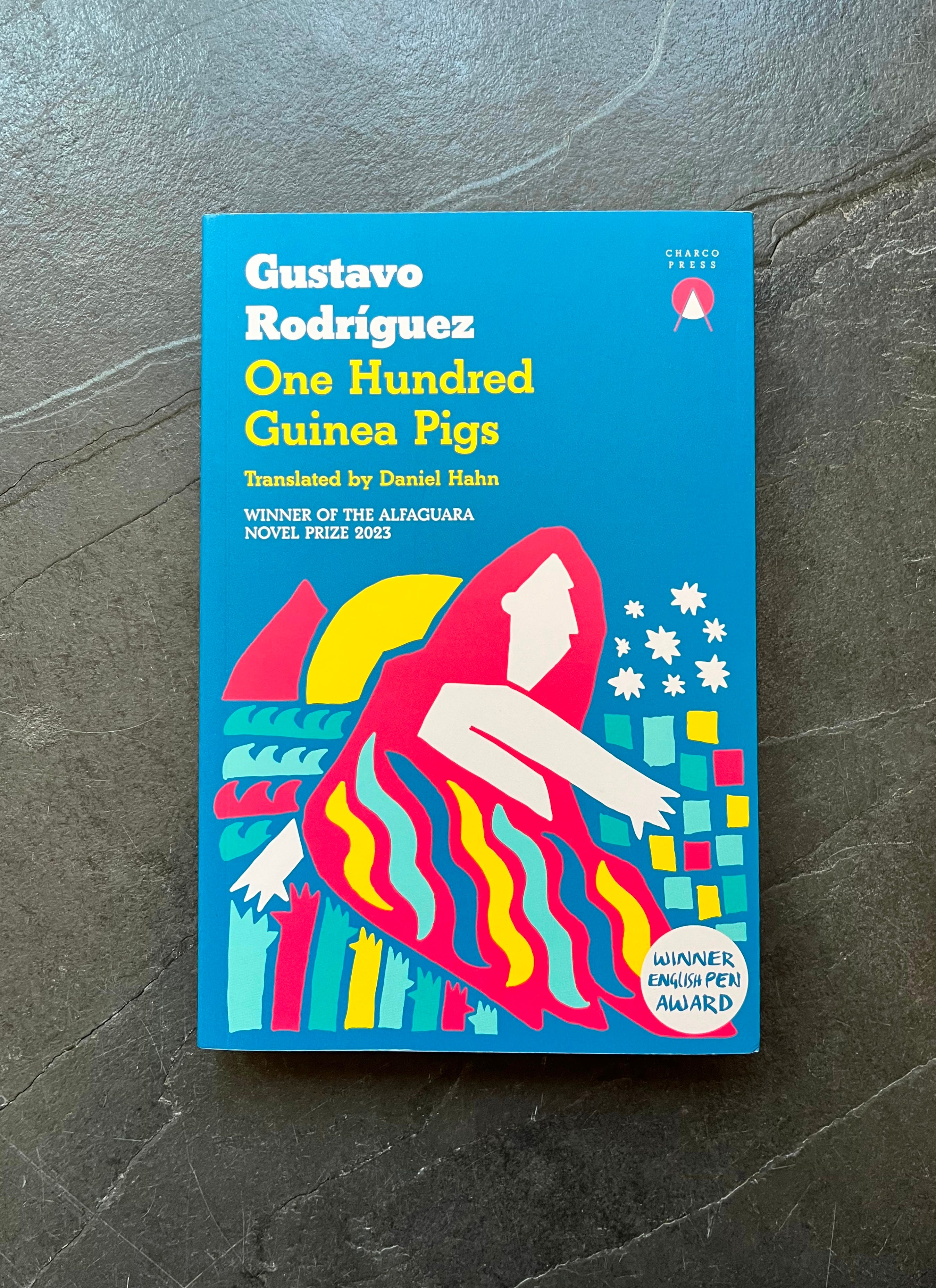
‘One Hundred Guinea Pigs’ by Gustavo Rodríguez (translated by Daniel Hahn)
Eufrasia Vela is a hard working care giver for the elderly, and embodies the role as more of a vocation than a job. She spends more time with them than her own son, as most of their family members do not see them. Doña Carmen, one of Eufrasia’s patients, is a bedridden, lonely elderly woman who spends her days staring out the window. A recently erected building obstructs her view of the sea and she is undoubtedly depressed. Boldly, she makes one last request of Eufrasia; to help end her life - and she agrees. Slowly more of her patients begin to make the same requests of her, offering to pay her handsomely. Dignity, respect and community are what Eufrasia offers her clients, and their friendship beautifully sustains her in the exact same way.
One Hundred Guinea Pigs is an outstandingly beautiful, life affirming exploration of what it means to die. Eufrasia, an alternative carer, develops such earnest and rich relationships with her patients that she unintentionally becomes a safe space for them to express they’d like to die. The only tragedy that this novel explores is the misfortune of aging without the right to choose when you want it to end. Rodríguez deftly explores the irony of most systems of care, which are designed to keep you alive for as long as possible, no matter the quality of life. What the novel interrogates the most is loneliness, and the isolation that is forced upon the elderly when they are put in care homes, removed from families and unable to have any agency over their day-to-day life. There are a rich variety of individuals who Eufrasia helps, articulating the diverse reasons one might want to die.
Perhaps the concept sounds bleak, but I can assure you it is not. It is heartfelt, funny and full of warmth about how death is not something to be scared of, but celebrated. It is compassionate in its exploration of old age, depicting portraits of the elderly who want to remain defiant in the face of deterioration, who are determined to exercise their autonomy until the end.
Euthanasia is a never ending, highly politicised debate that imbues almost all modern societies. Peru made the headlines in 2022 when Ana Estrada, who was suffering from degenerative muscle disease, was granted the right to end her life without her doctors facing legal punishment. One Hundred Guinea Pigs touches on this case, in a Peru where assisted dying remains illegal. Rodríguez criticises the sociopolitical and economic contradictions in Peru which could be applied to many societies, overarchingly arguing that there is a glaringly universal lack of empathy. While the older patients are central to this novel’s suffering, so too is Eufrasia, who has to work relentless hours, is underpaid and away from her family. Thus, the novel interrogates the landscape of injustice that permeates society for the young and the old. An imbalance the alternative reality in this novel attempts to rectify.
Rodríguez’ prose are tender and beautiful throughout, and his characterisation exceptional. This novel pierced me right in the heart, I was completely enthralled throughout and finished it feeling an emotional swell I haven’t felt for a novel in a long, long time. It is a gorgeous, humorous novel that purports that the most valuable thing in life is the relationships we have with each other. I have had complicated feelings about euthanisa ever since watching Better Off Dead? By Liz Carr, but equally understand how stories like Intervals by Marianne Brooker remind us of the excruciating, mortifying reality that some people are faced with when they cannot choose to end their own suffering. Ultimately, this novel presents a gently persuasive argument to legalise assisted dying that I felt incredibly moved by, because it is driven by Eufrasia’s compassion for those she loves so dearly.
I loved this book. I love how emotive Rodríguez’s storytelling was, and the perspective it has towards celebrating the rich, complicated lives we all hope to live. I would unequivocally recommend this and call it a buy! I think this might end up on my favourite books of the year list! It was just so sweet, well done and enjoyable to read.
And that concludes my July Reads! My favourite books of the month were Cosmos and One Hundred Guinea Pigs!
My first read for August is Taiwan Travelogue by Yang Shuang-zi, which is our book club pick!
Our first meeting is a week today, Sunday 9th August. The second meeting is a few days after, Wednesday 12th August. For those in book club, I aim to share the pre meeting material on Wednesday, so a few days before the first meeting. I am excited to hear your opinions!
End Notes
This month, my contribution to ’s ‘Right Book, Right Time’ series was published! It was a very full circle, emotional moment to reflect on how reading ‘Between Two Kingdoms’ by changed the trajectory of my life. You can read it here.
In July I published my interview with friend of the newsletter, Yu! For those unaware, I (kindly) coaxed Stacey into talking to me after an unfiltered rant she shared on her close friends story about how emotionally taxing being a debut author is. It was fun to probe, Stacey was a brilliant sport and I think the end result was a revealing, fascinating look at what the ‘publishing industry’ (as a business) does to the precious and personal identities of reader and writer. You can read it here.
The Booker Prize 2026 Longlist is out! I follow this list less religiously than the International Booker, but I still want to share my unsolicited opinions;
I guess I knew John of John by Douglas Stuart would be on here even though I thought very little of it. Why do previous winners always seem to get fast tracked onto future lists?! And are their editors too scared to criticise them? My unsolicited opinion is that’s what happened in John of John (see my review)
Speaking of previous winners (complimentarily this time) I am most intrigued by The Disappearers by Marlon James - which I have a copy of, so that bodes well!
I like the look of All Them Dogs, The Renovation and Switzy the most - but crucially not enough to pay an arm and a leg for them in hardback so we will circle back next year.
There is still time to contribute a book recommendation for Women in Translation Month for my new (redacted for dramatic effect) series I am bringing to the newsletter. I am looking for any women in translation recommendations - the more niche, the more likely they are to end up in the piece. The first edition will go live in a week or so. I’m excited for this. The contributions so far have been great.

Let me know your thoughts:
✹ What have you read and enjoyed in July? Do you have any recommendations for me?
☆ Have you read any of these books? Would you like to?
✼ What are you planning to read for Women in Translation Month? Share with us! There can never be too many WITM recommendations.
✵ What do you think of the Booker Longlist? Any strong reactions? Have you read any which you think deserve a place on there? Similarly have you read any that you think don’t deserve a spot? Do you have any plans to read some now they’re on the list? Let’s gossip about it.
In August I will be exclusively reading women in translation books. To say I am excited is an understatement. I did this last year and loved it - and you did too! I have ambitiously got a stack of 20 books which is ridiculous considering how much slower my reading has been this year. Let’s see how I get on - my goal is 9!
You will receive two WITM themed recommendation letters this month - one from the readers of this newsletter (you!), and one from me (like always).
I look forward to sharing them both and chatting women in translation all month long.
Thank you, as always, for being a reader.
Happy Reading,
Love Martha
If you enjoyed this, or anything else you see on Martha’s Monthly, why share it with a friend so they can enjoy it too!!
Catch up on what you might have missed:
If you’re curious, here is what I read in July 2023, 2024 and 2025.
Remember to subscribe if you want to receive *actually good* book recommendations straight to your inbox. <3
If you are unable (or don’t want to) pay for a paid subscription, but want to offer a little support, you can ‘tip’ me over on my Buy Me A Coffee page.
& share with a well read friend who you think might enjoy the newsletter!
p. 28 in Women Without Men by Parsipur
p.22 in The Book of Disappearance by Azem
p.388 in The Poisonwood Bible by Kingsolver
p.15 in Cosmos by Odoom
p.7 in Cosmos by Odoom