
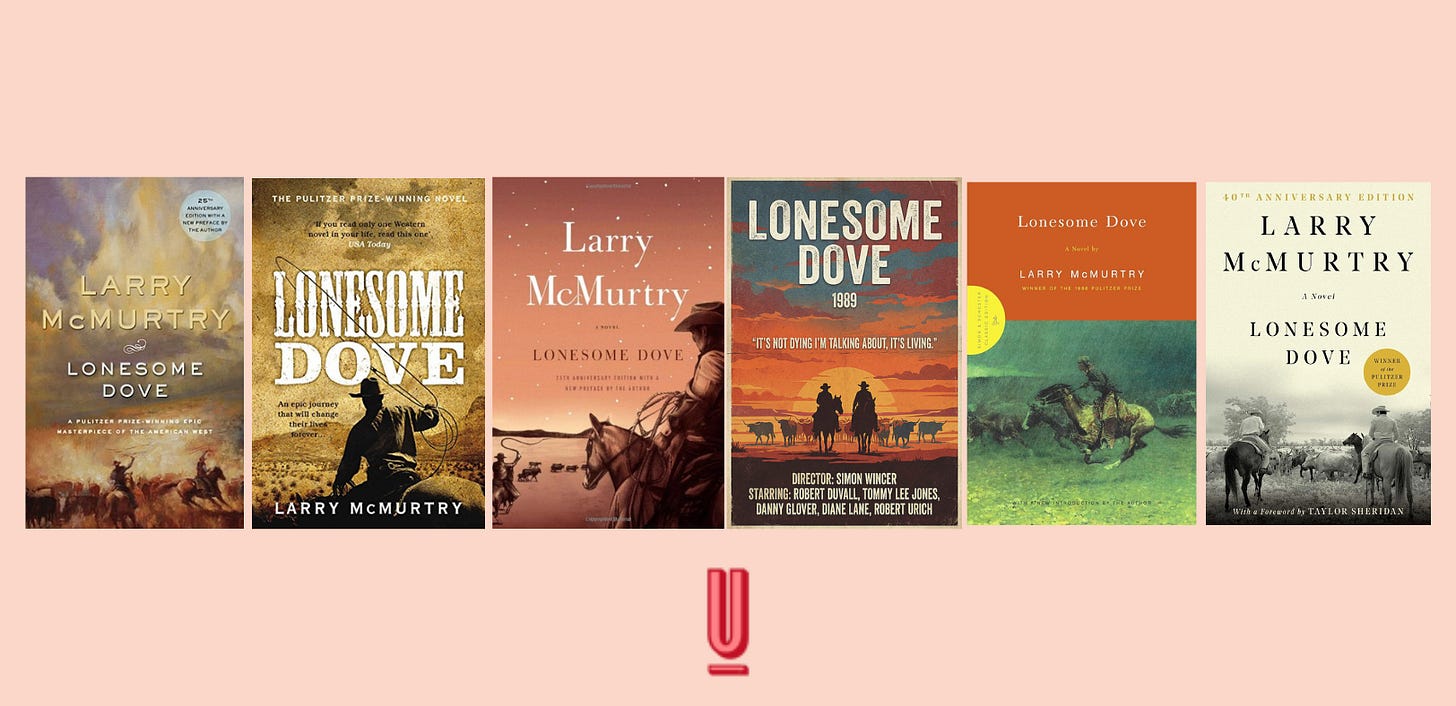
The Western from the eighties that took me all of June to read
I don’t think I have ever in my adult life spent a whole month reading one book, but it just happened. I spent the entirety of June reading Lonesome Dove by Larry McMurtry, the 1985 Pulitzer Prize-winning Western.
When my library hold came in, I was apprehensive. 857 pages??? The thing is a brick. Plus, it’s forty years old, plus it’s about cowboys during the time they slaughtered Native Americans and called them Indians.
I was intimidated and not entirely interested, to be honest. But some readers I really trust ( and ) had recently read it and raved about it. I thought I’d give it a try. And then I spent all month with it.
I’ve been sitting here trying to figure out how to write about Lonesome Dove. It’s not your typical book with one major, clear arc and a few smaller narrative threads. I can’t think of a book I’ve read that is more comprehensive or fully fleshed-out. It’s absolutely enormous, but the world the author creates is expansive, quite like the plains the cowboys travel. How does one write about a marvel like that?
The most basic, bare-bones way to contextualize it if you’re unfamiliar is that it’s the story of the Hat Creek Cattle Co.’s voyage from southern Texas to Colorado over the course of many dangerous months. They’re comprised of a handful of cowboys (two of whom are famous and feared Texas Rangers), 3,000 cattle, and two stubborn pigs.
For a fantastic review worthy of the book, I’ll direct you to , whose write-up includes nine gifs and no spoilers.
I love how the book vividly captures the strenuous and smelly cowboy life, as well as the beautiful and daunting landscapes. I love how the narrative never feels bloated or overdone; despite the book being more than 800 pages, the writing is crisp and evocative (McMurtry uses the word ‘Who?’ in the most devastating way I’ve ever read), and every page drives the story forward. I love the sense of ironic justice that hums in the background, and how the story reckons with the environmental and human costs of American expansion in the West. And I love how McMurtry gives his characters space to grow and develop in our minds with texture, nuance and a lived-in feel—even minor characters (like Janey the rock-throwing girl) get meaningful arcs.
Had I set out to properly review Lonesome Dove, I’d have hoped to say something akin to what’s above. McMurtry’s portrayal of the western landscapes is so evocative that you feel you’re there, afraid yourself of river snakes, dust storms, lightning strikes, and unfamiliar men on horses. The book spooked me in many ways. Some of it is so gory I wanted to close my eyes (there’s a castration scene that I fear I will never forget). But more of it is tender. These tough, hardened men have a beautiful vulnerability. McMurtry’s portrayal of the human experience is exquisite.
Lonesome Dove’s character development is unrivaled, which makes it easy to follow. The minute you open the book, the characterization jumps off the page. I decided before even making it to page two that I would read until the end. This almost never happens to me.
Aside from how incredible McMurtry’s development of the characters are, I could not get over their names. I pulled the following list of names from memory, which I think says a lot about McMurtry’s ability to illustrate these characters.
Deets
Pea Eye
Dishwater (Dish) Boggett, named because he was so thirsty one time he drank dishwater
Lippy Jones
Newt
Jake Spoon (I think this is one of the greatest names in literature)
Bolivar
July Johnson (no wait, this one’s the best)
Blue Duck
Dog Face
Cholo
Po Campo
Frog Lip
Soupy Jones
Peach Johnson
Reading about these tough cowboys who gulp whiskey and constantly talk about and pay for whores (their word! and one they use constantly!) is broken up by some pitch-perfect humor. One of the two famous Texas Rangers and the head of Hat Creek Cattle Co., Augustus (Gus) McCrae, is a chatty white-haired man who’s been married twice and doesn’t like to stay in one place too long. The joke is that he doesn’t like to work, but instead likes to sit and drink whiskey and play cards. (I felt hungover just reading about how much whiskey these men consumed.) Meanwhile, his partner Captain Woodrow F. Call, who rides his stubborn mare off every night to be by himself, only likes to work. The banter between these two hard-headed men is iconic. I was surprised to find myself laughing out loud.
What surprised me more than the humor was the vulnerability the cowboys revealed as the story went on. The idea of home meant more to some than others, but several of the cowboys expressed through interiority their pains at leaving a town they thought they hated until it was behind them. I found this touching and relatable. And while they speak of women in a very brutish way, some of them also display a deep respect for them, particularly our guide, Augustus McCrae.
Lonesome Dove is one of those books that earned its spot in the American canon. It will be awhile until I read another book by Larry McMurtry, but I know the time will come that I’ll want to be back in the plains, drinking whiskey and worrying about sand storms and river crossings. June 2026, the month I read Lonesome Dove, marks a turning point in my reading life.

Something else I spent most of June doing was watching the World Cup! And can we talk about the US win over Bosnia and Herzegovina last night?! After last week’s loss to Turkiye, we needed it. Those who are following it, who do you think we’ll see in the final? Chat soccer with me, please. I cannot get enough of it!
Thanks for reading! Love, Kolina
Questions for you:
Have you read Lonesome Dove? How do you explain the experience of reading it? Do you feel like it forever changed your reading life?
Are there any other Westerns I need to know about? This is not a genre I expect I’ll read a ton of, but I would love to read more when the timing is right.
Thanks for reading! Love, Kolina
- What are you reading? What are you underlining?
- What I’m reading: Let’s Not Go Overboard Here by Erica Hendry. This book is HYSTERICAL. I needed some levity after Lonesome Dove. I couldn’t have picked better.
When you purchase books through the links above, you support The Underlined and an indie bookstore of your choice at no additional cost to you.