
...but can we actually talk about didacticism in kidlit?
In some corners of the internet, crudgate rages on (like in this NYT article, or on Threads — yikes!). In others, the uproar has come to feel exhausting and silly. But before we move on, I want to linger on the notion of didacticism.
It’s a concept that the petitioners agitating for Mac Barnett’s ouster have honed in on. Their petition letter asserts, “When Barnett rails against the ‘didacticism’ of some books, we wonder who defines didactic? For Black and brown authors, for queer and trans authors, we have seen that very word used as a cudgel and dog whistle to decry the necessary diversification of children’s literature.”
In effect, though, this argumentation threatens to wipe an important set of questions from the board.
Actors across the kidlit landscape — from authors to publishers, from parents to teachers and librarians — need to consider:
Is it possible for children’s books to be didactic?
Do kids like didactic books? To what extent? How do we know?
Is the market oversaturated with didactic children’s fiction?
The fact that bad actors have used a word for ill intent should not strike the word from our vocabulary or our conversations. Questions of didacticism can and should live in the same conversation as other questions, craft and the necessary diversification of children’s literature among them.
Let’s begin.
I’ve posed some questions. Now, I’ll share some answers. My thoughts aren’t a destination; they’re one contribution along the way. Join me in an intellectual relay of sorts: consider, then take the conversation forward in your own life and mind.
Q1: is it possible for children’s books to be didactic?
The citation above attempts to invalidate this question entirely. It implies that anyone who cries didacticism must be cudgeling the book’s creator, and its use of quotes around the word didacticism implies that the word is itself a fiction.
We need to set this frame down.
Didacticism in kildit is as old as kidlit itself. You can google your own adventure on this, but Katherine Rundell’s audio essay, “The Lion, the Witch, and the Wonder” on BBC4, is a personal favorite. You can also see its echoes in a different author petition of sorts. If you want to stick to basics, Merriam-Webster defines didactic as “a) designed or intended to teach, b) intended to convey instruction and information in addition to serving another purpose (such as pleasure and entertainment), often overly instructive.”
So who gets to decide what didacticism means when it comes to children’s literature, and which books are didactic?
Literally everyone!
These are questions that anyone who participates in the making and sharing of kidlit should be asking and answering — iteratively, forever.
First, let’s add some shades of meaning.
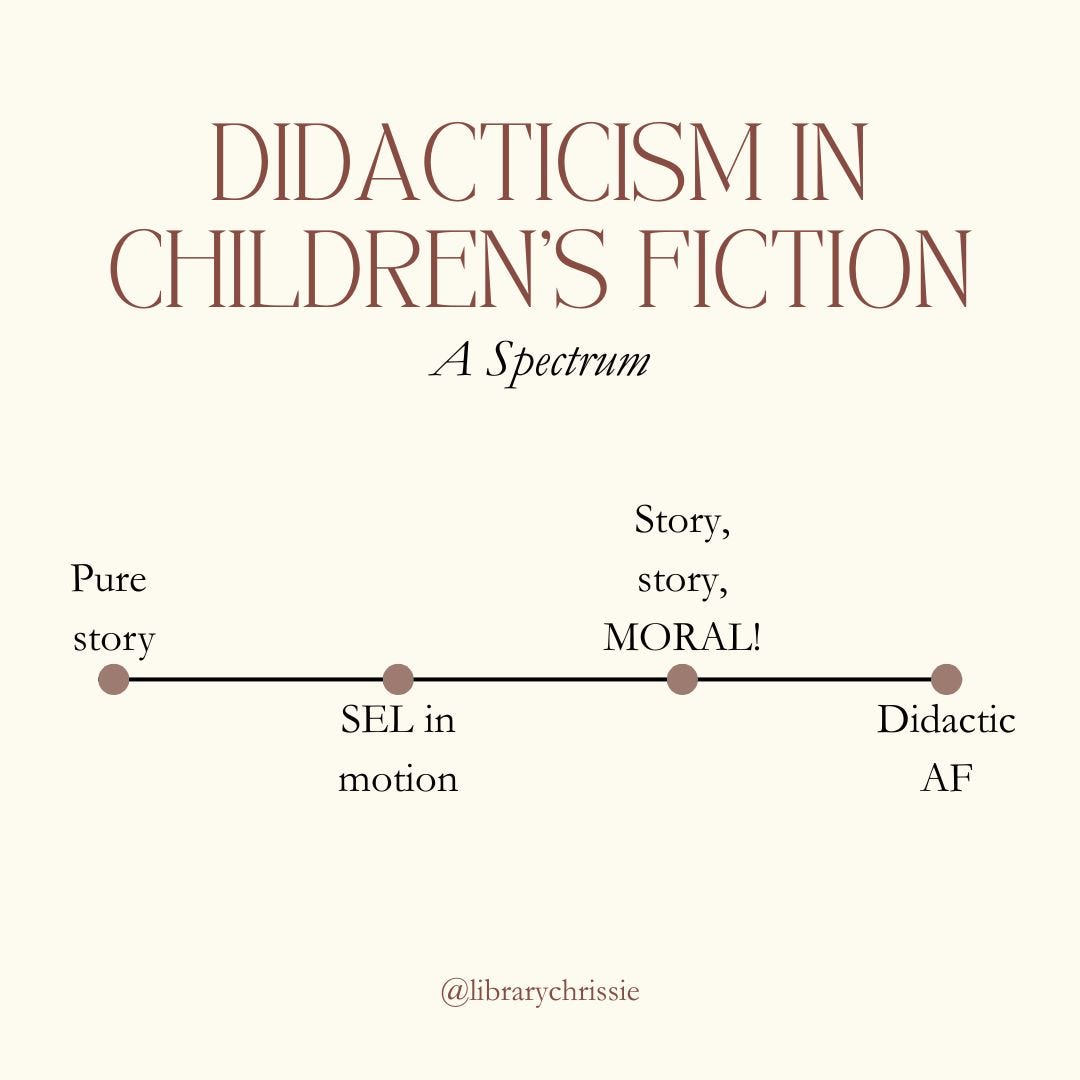
I propose a spectrum of didacticism for considering children’s fiction, ranging from “pure story” to “didactic AF.”
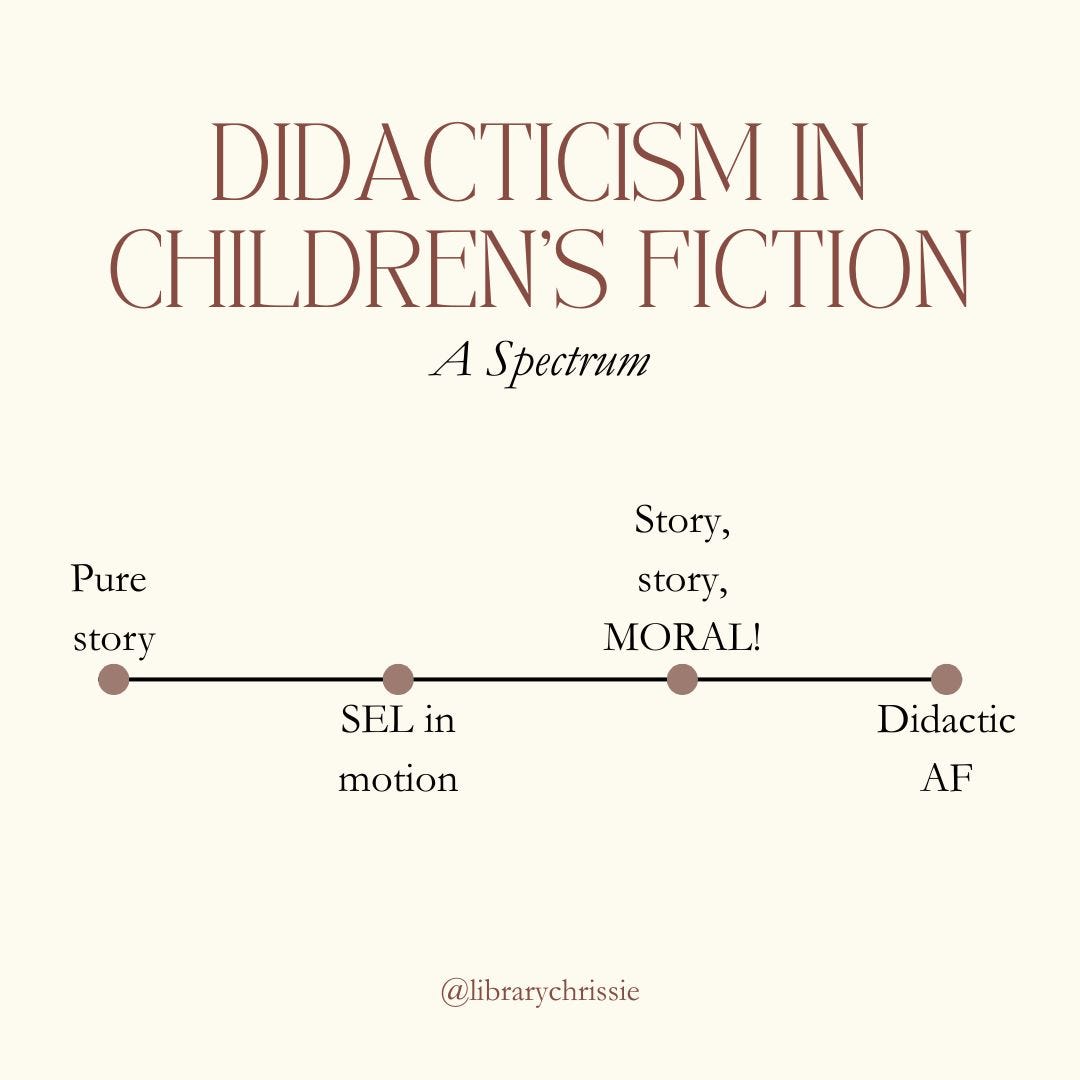
Pure story: these books let the words and actions of characters speak for themselves, though characters may engage with moral issues (this is living, after all!). While moral questions may be raised, they do not feel like the central aim or objective of the story. These narratives often leave open, looming questions for the reader to engage with beyond the page.
SEL in motion: a moral or social skill is clearly at the center of the story-telling, but the author leaves the moral/social skill to the characters. The reader makes inferences based on how the issue plays out on the pages. The moral/social skill is not explicitly stated in dialogue or by the narrator.
Story, story, MORAL!: these are books that feel like pure story until the last spread or two, then BAM! The moral/social skill is explicity stated, either by characters or narrator. Sometimes, this is a matter of genre (eg fable). Others, it’s something else…
Didactic AF: these are books where the moral/social agenda of the author drips from every page. Examples include affirmation books and books by psychologists/therapists (looking at you, Dr. Becky!).
I have opinions about these categories. So do you. So do kids. I have opinions about specific books in these categories. (So do you! So do kids!) We can hold all of this nuance in mind, without having to reject the question of didacticism altogether.
No doubt, we will add categories and shades of meaning to this diagram as time goes on. (You probably already have while reading.) As we move forward, how might we set down the binary categorization of didactic vs. not and instead think in degrees of didacticism and their uses?
Q2: Do kids like didactic books? To what extent? How do we know?
I do not have a large-n study or years of sales data on this (though I’d certainly like to). Instead, I have anecdotal experience based on watching 500 kids exercise choice in the library. I observe the same set of kids weekly, over the period of their six years in elementary school.
When I took over my current library, the picture books had been recently categorized to match the categories of our local public library. Two of the categories are “feelings” and “life issues.” Do you know the two lowest circulation sections of my picture books (by a mile)? Feelings and life issues. (I’m working on changing the categories, but that’s a topic for another day.)
I’m not saying that books in these categories should not exist — they are frequent favorites of counselors and teachers. Sometimes, externalizing a child’s struggle through a picture book helps them to see it more clearly. What magic!
But do kids like books that feel like they belong on this shelf? Do these categories appeal to them, broadly speaking? Do they come asking to check out the book their teacher used for their SEL lesson? No.
Likability and appeal are not the only criteria for fueling a child’s reading life, but they build its foundation.
Q3: is the market oversaturated with didactic children’s fiction?
Based on my conversations with children’s buyers at indie bookstores and many children’s librarians, yes. Many whose work includes curation and selection are frustrated by the feeling of wading through scads of story story MORAL and didactic AF to find the gems that will sell or circulate. (My personal feeling is that the proportion of books that fall in these two categories has surged since 2020).
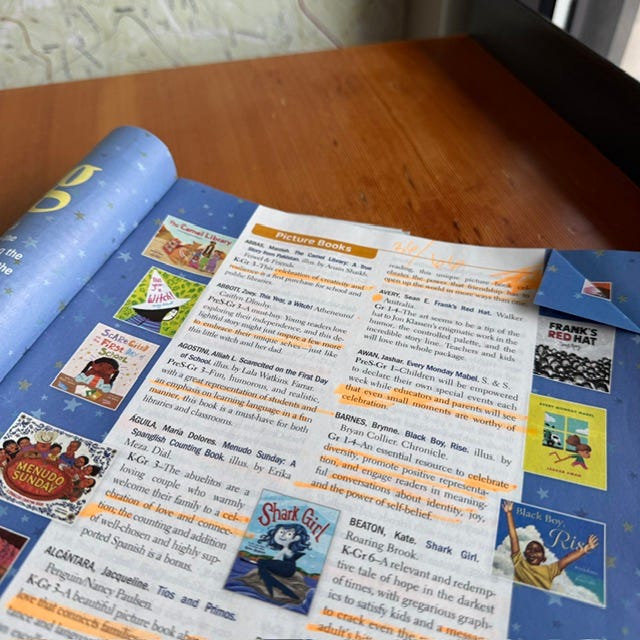
Beyond the numbers, the ethos of the industry is oversaturated with didacticism. Recently, when cleaning out my library office, I came across an old issue of School Library Journal, one where they compiled blurbs of all the books that had gotten starred reviews that year so far.
I got curious: how many of these blurbs center a moral or lesson that grown-ups want kids to learn? I expected it, but I was still shocked: more than half. What’s worse, many books with playful, satisfying storytelling that would bring radical delight to their readers were scrubbed into contrived moral takeaways. Reducing Every Monday Mabel to, “Children will be empowered to declare their own special events each week while educators and parents will see that even small moments are worthy of celebration”!? Come on!
Social media is similarly awash with the itch to use picture books to turn our kids into the kind of people we hope they’ll become, often emblazoning picture books with a projected lesson that may or may not be central to the storytelling.
Here’s a random recent example of one such Instagram carousel from a publisher (who makes many fabulous books I adore):
Then, there’s the dystopian SEO-smashing by online retailers. Twenty Questions by Mac Barnett and Christian Robinson is now “Twenty Questions: (Stimulating Curiosity and Creativity with Engaging Questions - For Kids Ages 4-8).”
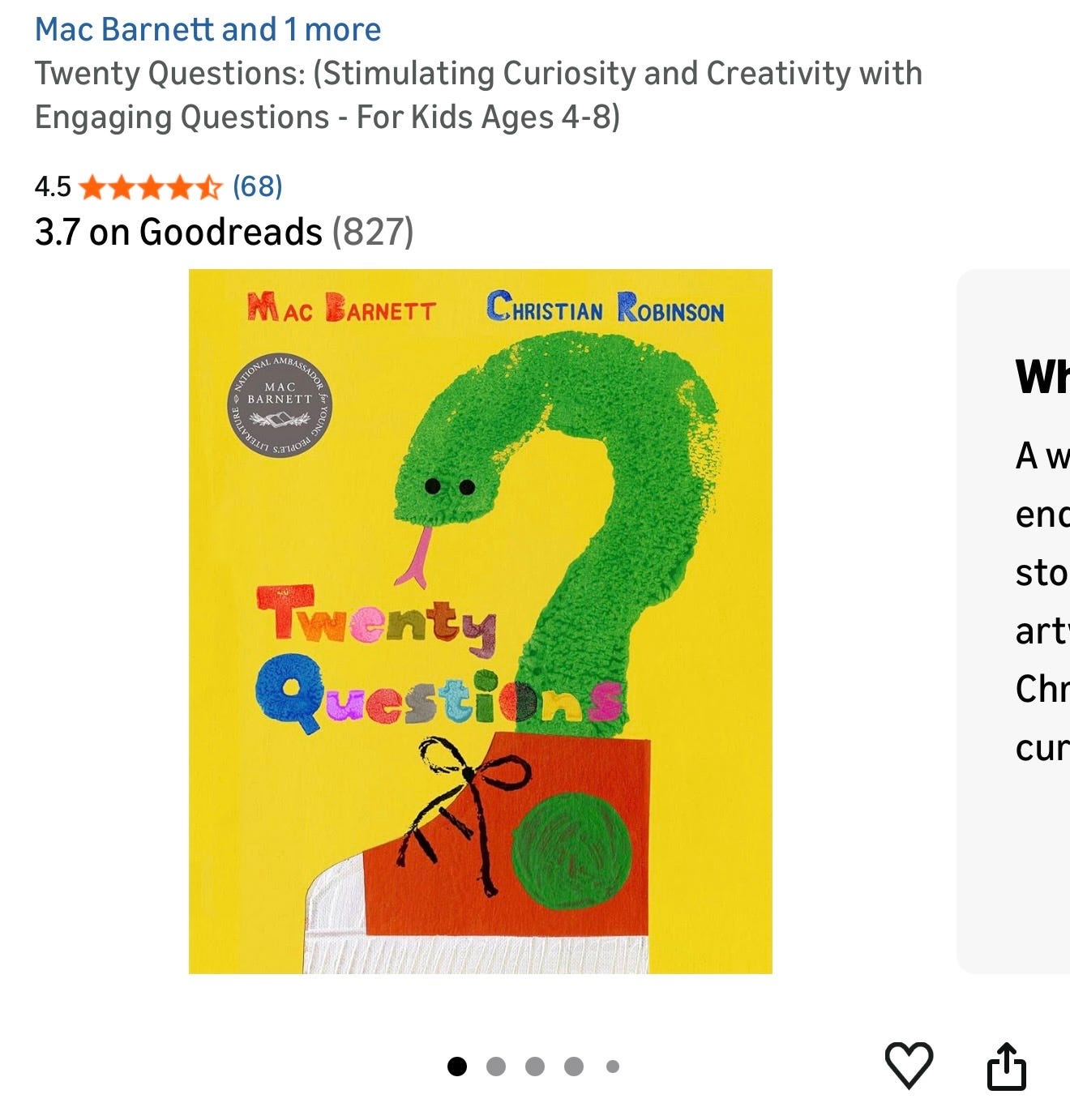
Across the children’s publishing industry, didacticism is in the water.
Wherever you sit, while you drink, start noticing.
Note: this type of essay is usually reserved for paid subscribers. If you enjoyed it and want to receive future posts of this nature, consider upgrading to a paid subscription.
Bits & Pieces
Year after year, I find some of my very favorite reading experiences via the FictionMatters Paperback Summer Reading Guide. Sara is my go-to for eclectic literary backlist, and her 2026 guide is out now. Rejoice.
I love short stories. They gel so well with how I think about great picture books: fiction that asks a question (then leaves the reader to answer); fiction that leaves you on the cliff’s edge, ever peering. I recently read this standout collection (out 6/9, paperback release). You know that feeling where you long to be reading your book when you’re doing literally anything else? I get that with novels a lot, but never short stories. Until this one!

Happy reading,
Chrissie