
AI writes about objects, we write about the light around them
I was listening to the Smartless podcast for a good laugh, as one does. It was a conversation with Sting and I was excited when host Jason Bateman asked him about his thoughts on AI. His response was perfect. He was speaking specifically about music, but I think what he says extends to all arts, including books.
He said sure, AI can create perfectly serviceable pop music you’d hear in a hotel lobby or airport, but he’ll know it’s AI almost immediately. When Sting listens to music, what he’s listening for is a human being having lived a life. Having had their heart broken. Having been in love.
“A machine can’t do that. A machine doesn’t have a family history, good or bad. It’s just a set of other people’s memories.” He goes on to say he doesn’t think we’re in danger of losing our ability to identify what’s machine-made and what’s produced by a heart-broken or in-love human. It just feels different.
We’ve already gotten good at flagging AI-laden writing. I think of Shy Girl, which has been lambasted for being heavily AI-generated. It was readers who first suspected it wasn’t entirely human-written. I think of Yesteryear’s author Caro Claire Burke sharing an essay someone wrote about her book. The essay is so obviously AI written, I was too embarrassed to finish reading it. I’m reluctant to place blame and cite AI detectors like Pangram, but some work, like the essay about Yesteryear, screams machine-made.
We readers are sharpening our ability to detect it. And those of us who create any type of art have another new skill to sharpen: finding ways to create that set us apart from AI.
“You’re competing with a kind of perfectionism that machines can give you,” Sting says in the interview. He then references how visual artists in the 19th century were challenged by the invention of photography. With photos, artists could create reality in such a detailed way that painters could no longer compete.
But, he said, instead of trying to compete, they created the impressionist movement.
“They weren’t painting objects anymore, they were painting the light around objects.”
I was driving when I heard him this. I paused the podcast so I could think, then I rewound it 15 seconds and listened again. Then one more time. They were painting the light around objects instead of focusing on the objects. Brilliant!
Sting suspects human musicians will sidestep this AI perfection and create something better. I believe authors will do the same. They’ll focus on the light around the objects; the secondary and tertiary ways falling in love or having our hearts broken reflect light or darkness on our lives.
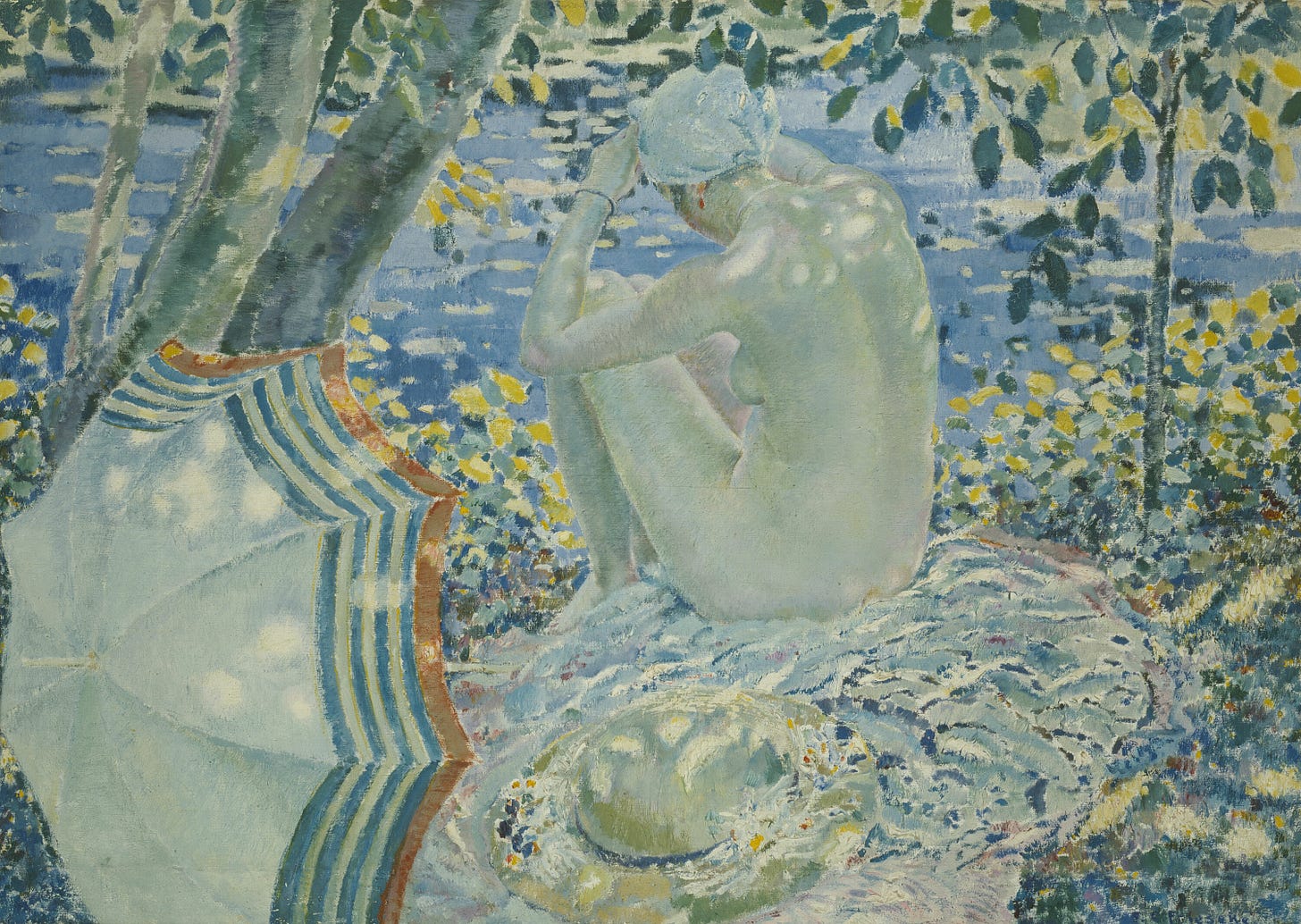
Consider this painting by Frederick Carl Frieseke. I’m struck by how the light falls on the woman’s shoulders; by the droplets of sun on the umbrella. What a beautiful impact the technology of photography had on paintings.
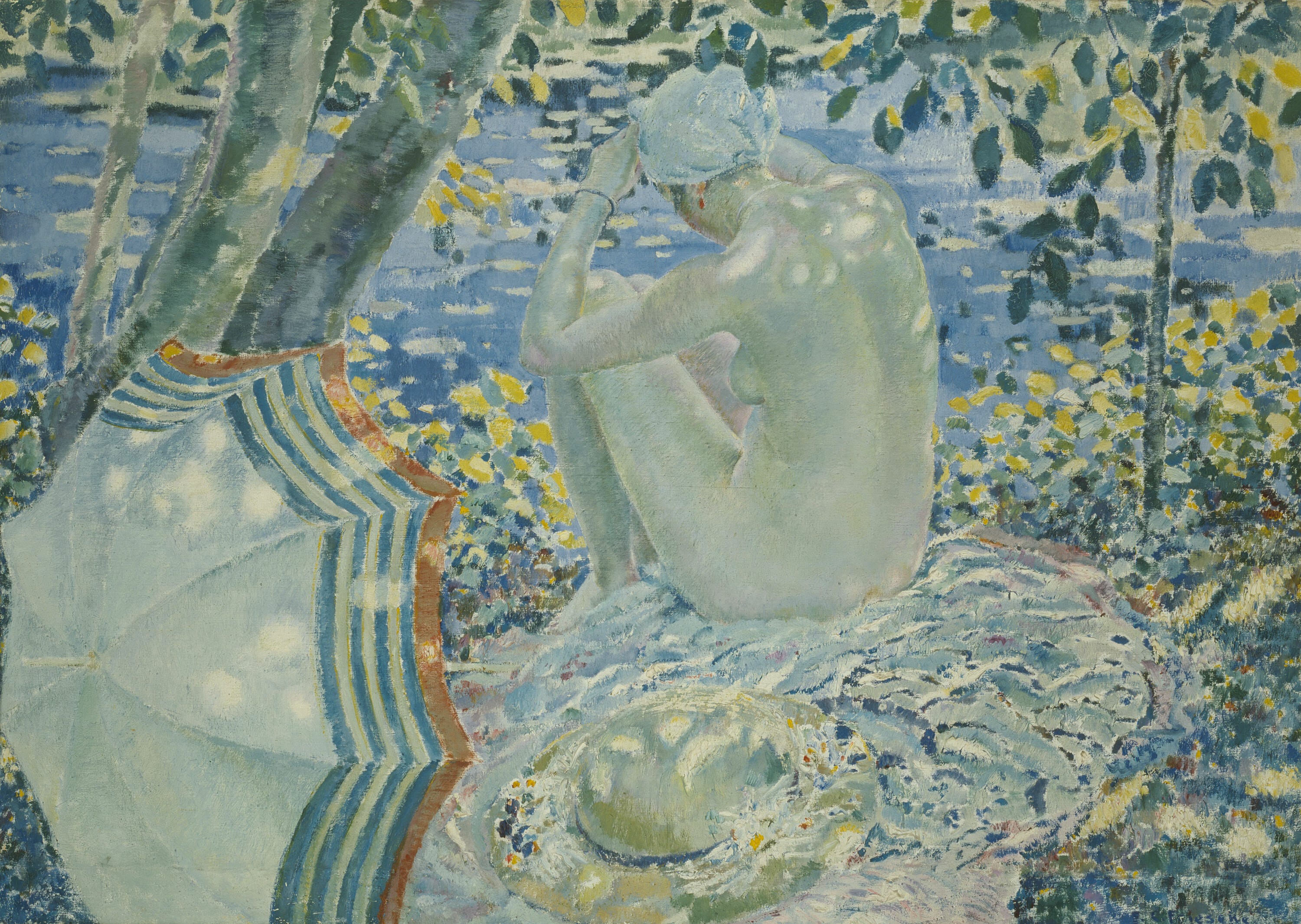
In trying to apply what Sting said to books and writing, I keep coming back to Claire Keegan’s Small Things Like These. AI would never come up with that book because — what even is it? It’s not the plot that seduces readers, it’s the way the father observes the sounds in the cold Christmastime streets. It’s how he quietly process what he sees when delivering coal to the convent. Ditto Samantha Harvey’s Orbital, a book virtually plotless but absolutely spectacular. Samantha Harvey wrote about the light around the objects. Literally. She wrote about Earth from space:
Out there it’s Argentina it’s the South Atlantic it’s Cape Town it’s Zimbabwe. Over its right shoulder the planet whispers morning — a slender molten breach of light. They slip through time zones in silence.
Quaint is the word that comes to mind.
Publishing loves an explosive book because explosive is what you can adapt into movies or tv shows. The bigger and shinier, the better it’ll look on camera. AI can achieve this by collecting thousands and millions of other peoples’ memories. But what it can’t do is rip a reader’s heart out by bringing them through the experience of seeing a lover some 30 years later (Heart the Lover). It can’t create the thousands of nuances of a friendship between two women over a sixty-year timespan (the Neapolitan Quartet).
It’s the quaintness — the droplets of light — that move readers to feel something, and those are the stories I want to spend time with. It just so happens that those kinds of stories are unaccessible to unfeeling, unloving machines. For those reasons, Sting isn’t worried about AI coming for the arts. Who are we to argue with him?
Questions for you:
What books are you reading that fit the bill for quaint and/or decidedly human? What signals to you that a book is human-written?
Conversely, what’s your AI giveaway? For me it’s the super choppy writing. The punchy, fast-paced, no-nonsense stuff. I personally love a meandering sentence that lazes around the senses and repeats or wanders.
Where are my Smartless fans? I’ve been bingeing on it for the past couple of months and it makes me obcsenely happy.

Thanks for reading! Love, Kolina
- What are you reading? What are you underlining?
- What I’m reading: I finished The Lowe Job by Grace Alexander last night. It’s basically a British version of the Kardashians — and it’s delicious. (It comes out June 16 by William Morrow). Over the weekend I read The Cafe on the Edge of the World by John Strelecky. I immediately placed it on my husband’s TBR pile (though I do have some nit-picky notes about the writing).
When you purchase books through the links above, you support The Underlined and an indie bookstore of your choice at no additional cost to you.