
What special ed students taught me about the power of believing in someone
Hello and happy beach read season! ☀️
Yesterday was my first day of summer and I am finally coming up for air. In a strange series of events, I found myself entering a completely new career this winter; one I hadn’t sought out and never would have considered prior. In early February, I became the long-term substitute teacher for a special ed class of eight first and second graders.
This Tuesday was my last day and I am just now beginning to process the past several months.
Since my Covid-induced layoff in 2020, I haven’t had a job that required me to show up somewhere every morning. I spent all these years working from home and caring for my two children. This was the first year they both went to school full-time, so in the fall, I began looking for writing work. I applied to gazillions of jobs. I have 15 years of professional writing experience. I’m working on my third novel. I have a newsletter with actual, real-life subscribers. You’d think I could have found a job!
But I could not. It was demoralizing and confidence-shattering. I felt rudderless, aimless, and worthless. My confidence scraped the lowest of the lows and I wanted to give up on all my writing. It got particularly bad in January after two great interviews at an organization I really wanted to work for. I had several people vouch for me and was over-confident the job was mine. When I received my rejection in response to my thank you email, I read the email to my husband and went up into my bed and cried. My kids checked on me and rubbed my arm, combed my hair with their fingers. And then they left me to cry alone, as I wanted.
This was a Thursday. I gave myself the following day to work on my novel while the kids were at school. No job hunting, no feeling bad about writing instead of looking for work, just writing. I gave myself the weekend and Monday, a no school day, to grieve and just be with my kids. Tuesday I would figure out my life.
Tuesday morning came and I journaled. Over the summer, I had applied to be a substitute teacher at my kids’ school. The school is in my backyard and I loved spending time there. So when a friend suggested I try subbing, I applied for a license, paid for my background check and fingerprinting, and swiftly forgot about it. While journaling, the idea of subbing popped up. I had subbed exactly one time the month prior and got my ass handed to me by thirty first-graders. And it had only been a half day. But the principal at my kids’ school had called a few times to see if I could sub, so through my journaling I made a plan: I would sub two to three days per week and work on my novel the other days. No job hunting, no feeling bad that I was writing instead of cleaning the house or running errands. I would treat my novel writing as a job and show up accordingly. I would do this for the rest of the school year and then stay home with my kids for the summer. It was a perfect plan. I was pretty jazzed about it, and I quickly got the buy-in from my husband (subbing a couple days a week wasn’t quite the monetary contribution we’d been looking for, so I had to make sure he was okay with it).
This plan lasted two weeks.
In the second week of my new plan, I subbed for a special ed classroom. I don’t remember saying this but the school secretary fondly remembers me showing up my first day and declaring I had no idea what I was doing, but I am a mom and I was going to figure it out. Within minutes of meeting the kids, I was in love. Similarly, the EAs (educational assistants) were fun and quirky and I could tell they cared deeply for their students. I felt strangely at home, despite having no idea how to run a sped classroom.
Before the day was over, the EAs mentioned the teacher I was subbing for was trying to take a leave of absence. If I liked it, they said I should come back the next day. So I did. And then the next day, and then the following week, and then the principal asked if I’d like to stay for three months. So I did! And that three-months extended through the end of the year.
For the last several months, I assumed an alter ego.
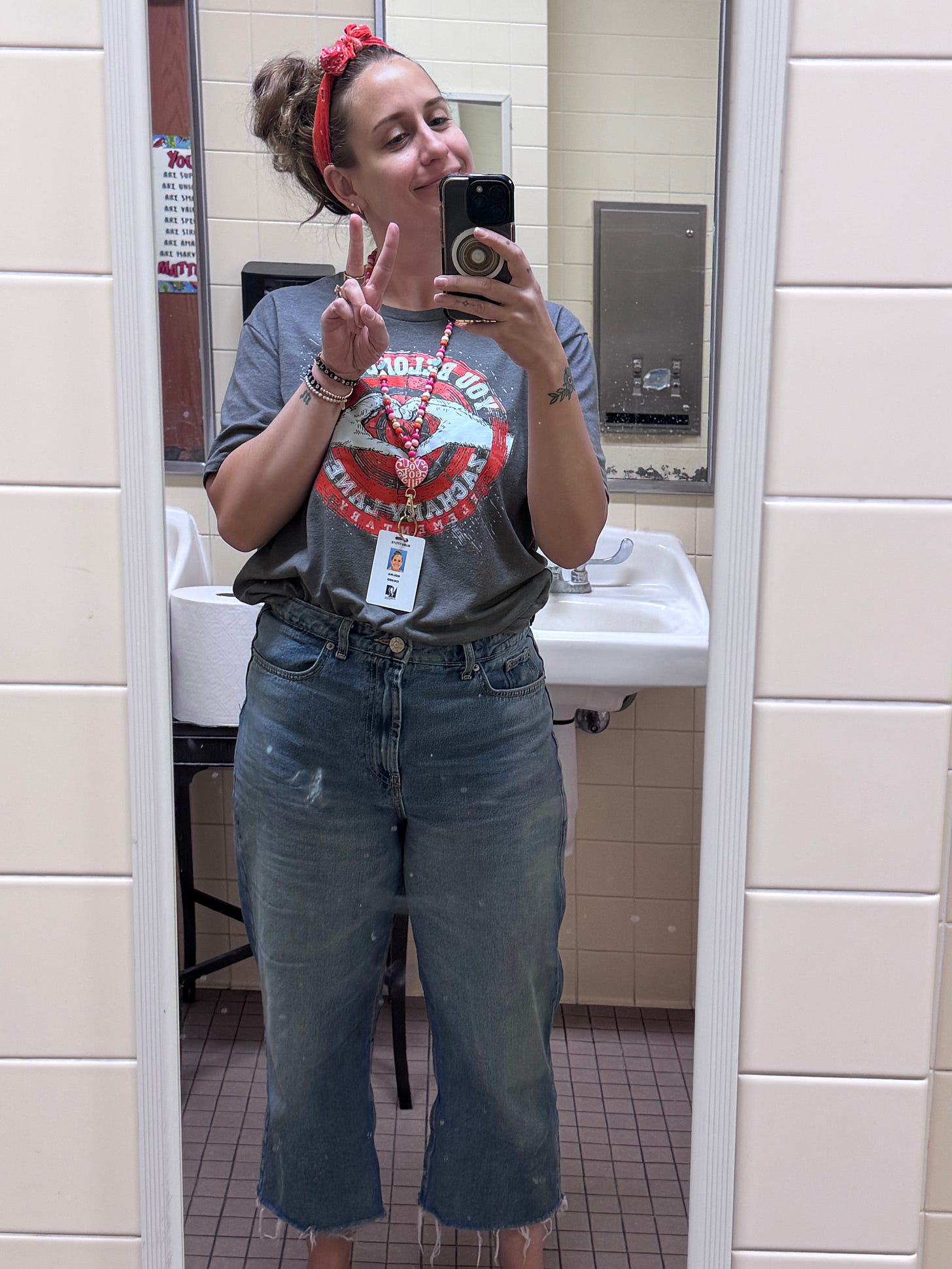
Introducing Ms. Cici
In a special ed setting, the students call the teachers by their first names. I arrived to this classroom as the fourth person with a name starting with the K sound. I quickly decided they could call me Ms. Cici instead of Ms. Kolina — Cici as a nickname for Cicero. The kids took to it immediately.
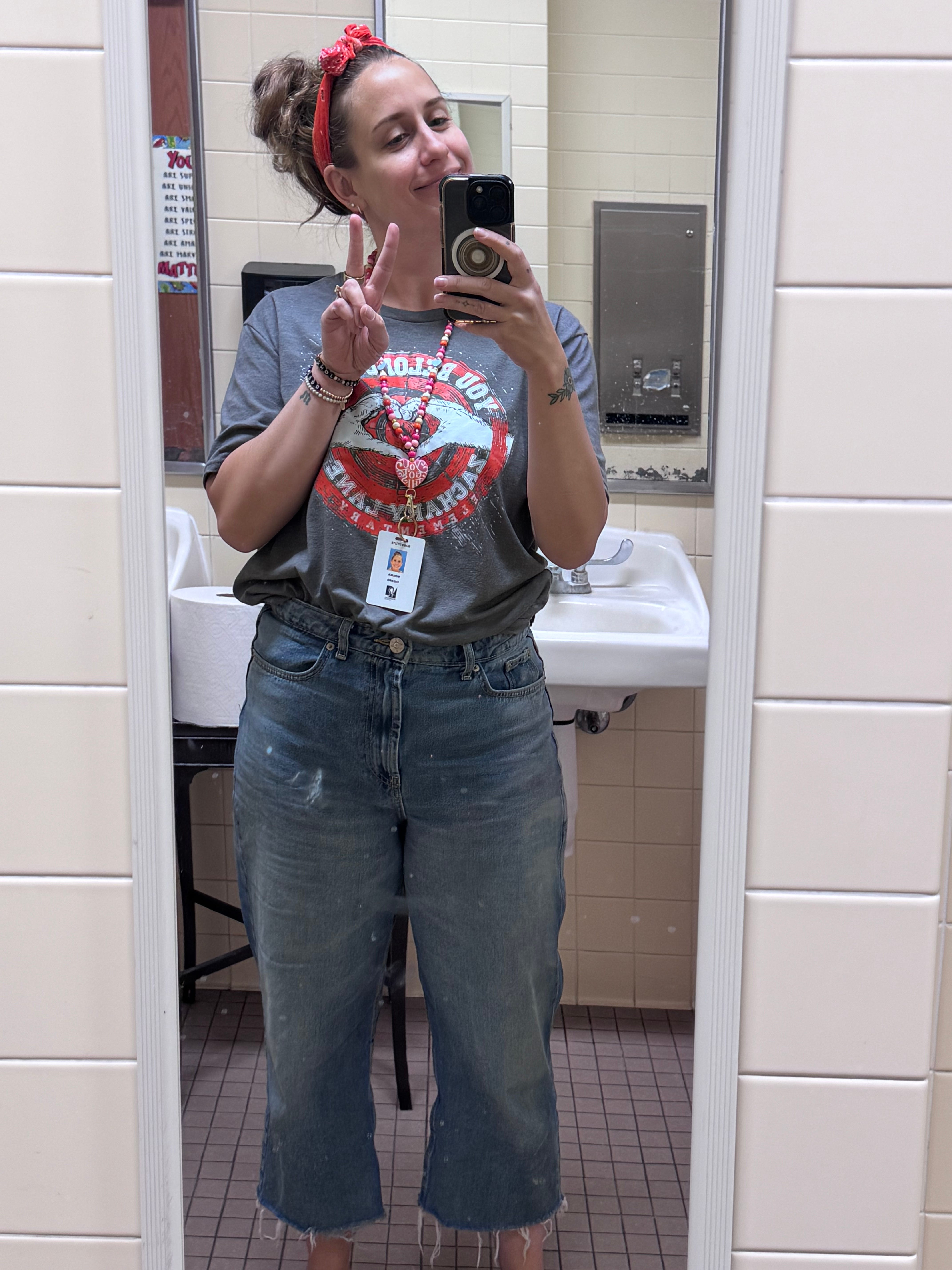
I took this photo one day when I realized how fully I’d assumed the special ed teacher role. I sent it to my two best friends, both of whom are educators. Nailed it.
There’s a point to this story, and one that relates to books and reading, but also to humanity as a whole. I don’t have a degree in education, I’ve never taught in a classroom, and I have no special ed experience. There were more weird things about me having this job than there were normal things about it. But the principal assumed my competence. He told me on Tuesday that on my first day subbing, he popped into the classroom to check on me and saw that I possessed something you can’t teach: passion. He saw something in me and decided to provide me with the opportunity to live into it, and I really, really did.
Now that I’m done and have come up for air, I look back on my time as Ms. Cici and realize I have never done such meaningful work. I was excited to get up every morning and be greeted by my students. Ms. Cici! They’d call and they’d come hug me and they wouldn’t question what my background was or why I was their teacher. They assumed my competence, too.
In turn, I assumed theirs. I taught several of my students how to read. Five, to be exact. They had the fundamentals prior to my arrival, but when I became Ms. Cici, I introduced a regularity to the classroom that they hadn’t seen yet this year. Every day we did Letters. We read CVC (consonant-vowel-consonant) words, me up on a whiteboard with big hand-made letter magnets and the students with little letter tiles on their desks. I believed in these kids and guess what — it worked. They went into summer knowing how to read.
I introduced something else to these students that, after a time, they came to do without me having to tell them: Independent Reading Time. When the students returned from recess and lunch, they would walk straight to the bookshelf in the back of the classroom, grab a book, and find a cozy spot to read independently for 15 minutes. Few of these students read the books word for word, but they quietly spent time with them, and that’s what was important to me.
On the smart board in my room, I’d have a slide up that says Independent Reading Time. A second grade teacher came into my room one day when the slide was up and asked if it actually worked. How could kids who couldn’t really read do independent reading time for 15 minutes?
I think the question should have been, why wouldn’t it work?
And how did this second-grade teacher not assume their competence? It hurts my heart — actual, physical pain in my chest — to think about how underestimated my group of students have been in their lives and will continue to be. Not every one of their teachers is going to assume they can read. And if they don’t try it, they may never know, as not all of the students have the ability to say, unprompted, “I can read!”
I went into this job with no experience and no real idea of what I was doing. But I knew one thing: I was going to believe in them.
And I did.

I started this newsletter by writing about a children’s novel I read (A Long Walk to Water by Linda Sue Park) and ended up giving you a play-by-play of the past few months instead. Expect a post about the book soon.
P.S.: I ended up getting an offer to teach in a special ed classroom next year, this time not as a sub but as the actual teacher. I said no for reasons I won’t get into here (though I would truly not be surprised if I ended up doing it anyway). Until I find something else as meaningful as the work I did the past four months, I think Ms. Cici will continue to sub in special ed classrooms. 🤓
Questions for you:
Peoples’ worlds can rip wide open if only you assume they are competent. I’d love to hear your experiences with this.
If you have children or are a teacher, how do you instill the love for reading in them? I think I naturally inspire kids to read because I can’t really shut up about it, but I’m curious to know how parents and teachers do it with intention.
Thanks for reading! Love, Kolina
- What are you reading? What are you underlining?
- What I’m reading: What is the What by Dave Eggers
When you purchase books through the links above, you support The Underlined and an indie bookstore of your choice at no additional cost to you.